The Canadian Term Spread and the Case of the Missing 2024 Recession
The term spread is positive in Canada through September. But the term spread signaled recession for 2024 (which some had predicted). What can we take from this, regarding recession probabilities? In part, the answer depends on what recessions have been identified. That in turn depends on the interpreter. For Canada, there are at least three: […]
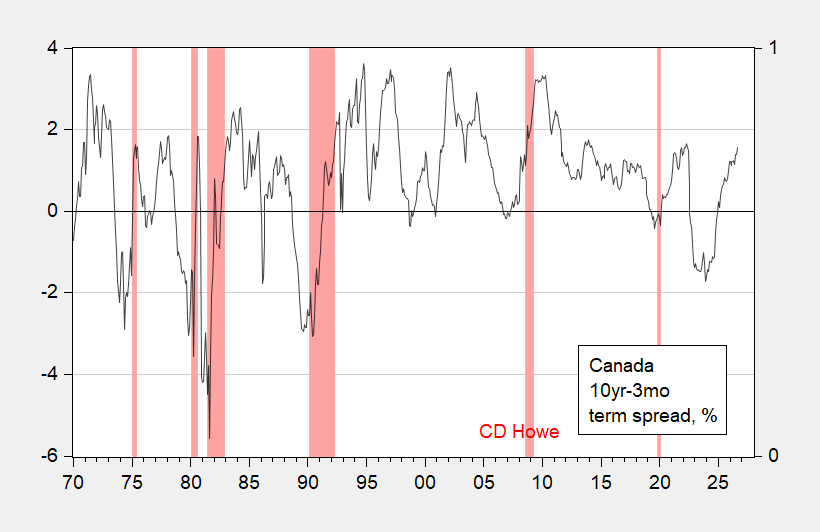
Canada's term spread has remained positive through September, despite signals suggesting a recession could occur in 2024. The interpretation of recession dates varies among analysts, with at least three different views: those of CD Howe, ECRi, and Philip Cross. Figure 1 displays the Canadian 10-year to 3-month term spread and the recession dates predicted by CD Howe (pink shading).
Figure 2 shows the same for ECRi (pink shading), and Figure 3 for Cross (also pink shading). The 2020 recession has been aligned with ECRi's dates in Figure 3.
Historical analysis indicates that the 10-year to 3-month term spread model, estimated using pre-pandemic data, would have predicted a 2024 recession at a 40% threshold. However, it failed to predict the 2008 recession and the 2020 recession as well. Using a broader dataset, a recession would have been predicted with a 35% threshold.
Furthermore, some regression specifications applicable to US recessions also predicted a Canadian recession with a 40% threshold. However, the debt service augmented regression would not have done so.
The term premium augmented specification also failed to predict a recession. Nevertheless, the Canadian term spread has never been so positive, followed by a recession, at least since 1970. Consequently, the evidence suggesting a potential recession based on the term spread is not particularly strong. This conclusion is consistent with historical correlations, which did not indicate a recession in 2026.
While the indicator cannot account for unforeseen surprises, such as a major trade war escalation, in the immediate 12-month outlook.
Written by urgent.news from Econbrowser's reporting — not their text. Machine-written — may contain errors; check the original before relying on it.