Prompt Engineering Is Dead. Context Engineering Is What Actually Matters Now.
Here is the complete guide, what it is, why it matters, and exactly how to do it.
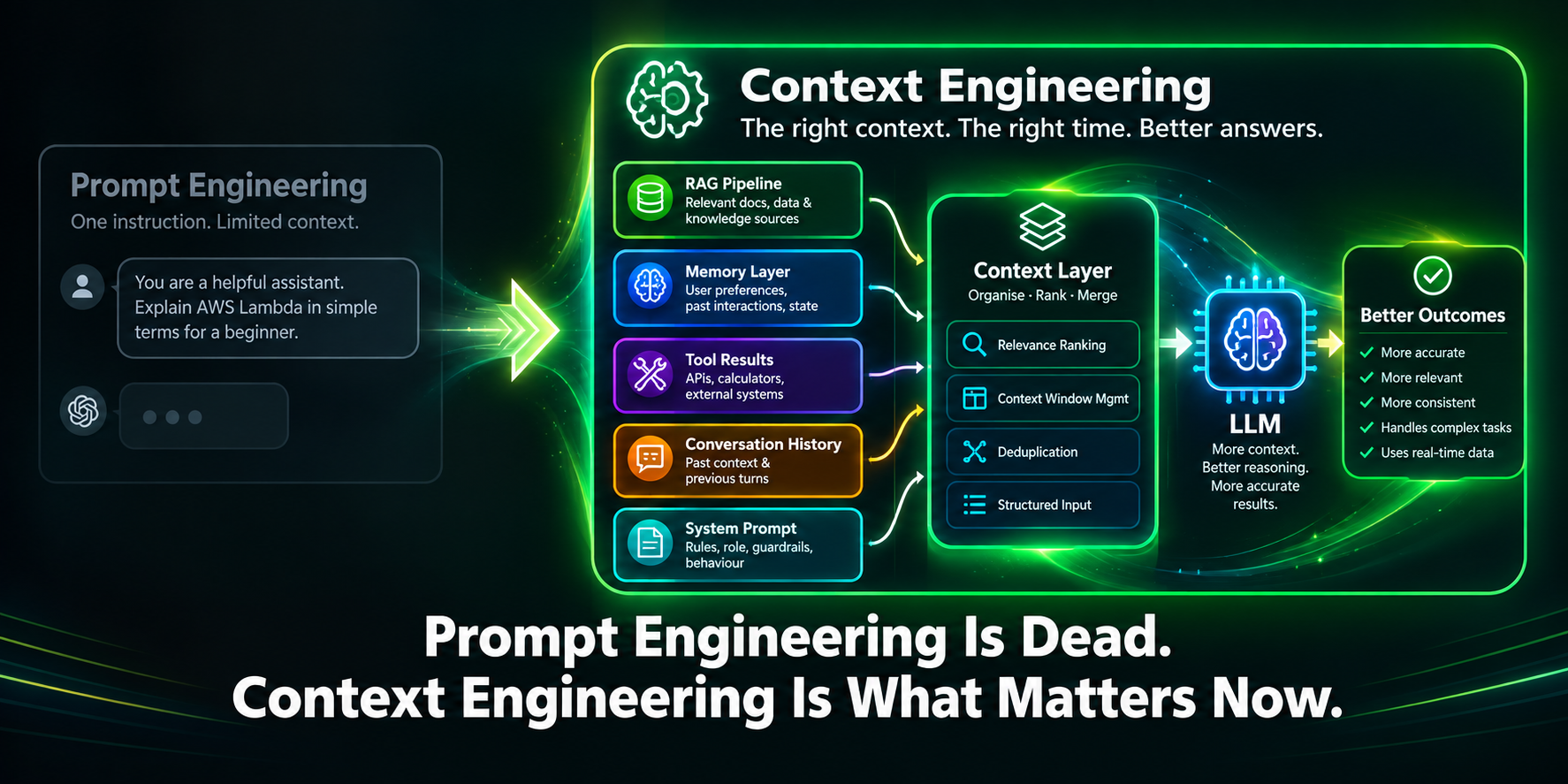
In 2023, the key to achieving success with AI models lay in crafting prompts correctly. By 2026, however, models were advanced enough that prompt wording no longer posed a significant hurdle. The new bottleneck emerged: the information the model possessed when it provided an answer. This realization led to the emergence of context engineering, a discipline focused on designing all the information the model encounters, not just the prompts.
The author recounts a personal experience with a customer support AI agent that provided inconsistent answers. Despite extensive efforts to perfect the prompt, the agent continued to give inaccurate or confidently wrong responses. After consulting a colleague, the author realized the true problem was not the prompt, but the lack of sufficient context. The model lacked essential information required to accurately address user queries.
Prompt engineering, which had gained traction in 2022 and 2023, involved optimizing the wording of instructions given to the model. Techniques like chain of thought, few-shot examples, role assignment, and clear formatting proved effective in getting the model to perform specific tasks. However, those techniques had their limits.
They assumed the model had all the necessary information to carry out the instructions. When the model lacked crucial data or context, no amount of refinement to the prompt could rectify the situation.
In 2025, Andrej Karpathy, a prominent figure in the AI field, introduced the term "context engineering" to describe this shift in focus. He argued that the leverage in modern AI systems had moved from how instructions were phrased (prompt engineering) to what information surrounded the model (context engineering). By 2026, with models reliably following instructions, context engineering became the primary variable in achieving AI success.
Context engineering involves optimizing all elements a model encounters when generating a response, beyond just the prompt. The five layers of context include:
1. System Prompt: The persistent instructions given to the model, which still holds significance but should be concise and focused.
2. Conversation History: All previous interactions with the model, which must be efficiently managed to avoid overwhelming the model.
3. Retrieved Documents: Knowledge pulled from external sources, such as knowledge bases or the web, that can supplement the model's understanding.
4. Tool Results: Outputs generated by external tools, APIs, or databases that provide additional data for the model.
5. Memory: Information persisted from previous sessions, allowing the model to maintain context over time.
Context engineering requires careful consideration of each layer, ensuring that the system prompt is minimal and focused, conversation history is well-managed, retrieved documents are relevant, tool results are accurate, and memory is appropriately utilized. By optimizing the entire context surrounding the model, rather than simply refining the prompt, context engineering enables AI systems to deliver more accurate and contextually relevant responses.
Written by urgent.news from HackerNoon's reporting — not their text. Machine-written — may contain errors; check the original before relying on it.