Las firmas de lujo pierden 250.000 millones de euros de valor por la caída de la demanda china
La desaceleración en China y el enfriamiento de las bolsas mundiales están agravando la crisis del sector europeo. Leer
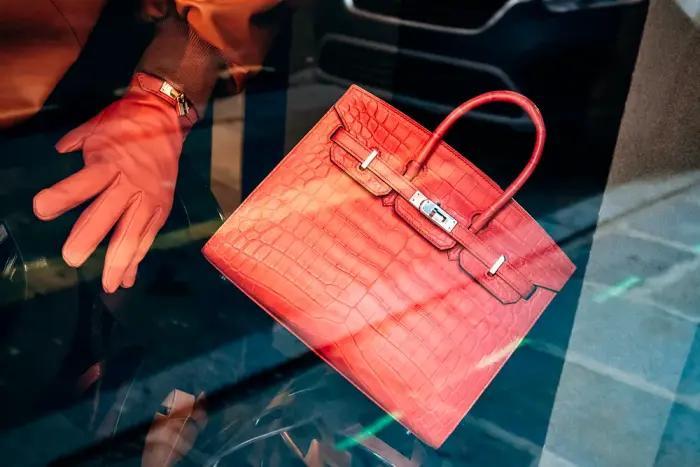
European luxury brands have suffered a market value loss of nearly €250 billion this year due to weakening Chinese consumer spending and volatility in global stock markets, according to the latest earnings reports from LVMH, Hermès, and Kering, the parent company of Gucci. The disappointing results from LVMH, Hermès, and Kering have exceeded market expectations that had already been significantly revised downward, confirming fears of a prolonged crisis in the luxury sector.
The six largest European luxury brands listed on the stock exchange, including Richemont, Prada, and Moncler, have collectively lost €251 billion in market value this year. The steepest declines were seen in LVMH and Hermès, whose market capitalizations shrank by €131.6 billion and €93.3 billion, respectively. Chinese consumer demand, which had driven sector growth for over a decade, has weakened in recent years due to a prolonged real estate market crisis and a lagging stock market.
Monthly retail sales growth in China, the world's second-largest economy, averaged less than 0.5% over the past six months, marking a sharp slowdown compared to the previous year.
Analyst Luca Solca of Bernstein noted that the expected recovery in Chinese luxury consumer spending has stalled, leading to a decline in results, downward pressure on stock prices, and internal reflection for the companies. For LVMH, Kering, and Hermès during their earnings presentations this month, the deterioration in China's situation was highlighted.
LVMH's financial director, Cécile Cabanis, stated that fashion and leather goods sales, a key segment for the group, fell by around 15% globally among Chinese customers. "The slowdown [in fashion and leather goods] is due in large part to the Chinese clientele," she added. "We hope this trend will ease, but we do not know when."
Kering, which also owns Saint Laurent and Bottega Veneta, is facing an even more severe situation. Chinese consumer sales fell between 15% and 20% across the group during the third quarter, accelerating from the previous decline of around 15%. The cooling in China has begun to impact even Hermès, one of the most resilient luxury brands.
Global sales of its apparel and accessories division fell by 2%, and Hermès' financial director, Eric du Halgouët, said that recent declines in the Chinese stock market, combined with restrictions on foreign-held assets, have complicated the company's situation. A new regulation came into force this week, imposing a 20% tax on dividends and interest generated by trusts in foreign jurisdictions.
Meanwhile, China's CSI 300 index, tracking the 300 largest Chinese companies, has fallen by 19% over the past four months, with losses exceeding $2 billion (€1.7 billion) as fears of internal consumption weakness and a potential AI bubble persist.
While some companies have reported positive trends, such as a 10.8% increase in Hermès' high-end bag sales and strong demand for jewelry brands like Tiffany and Boucheron, both owned by LVMH and Kering, respectively, the recent slowdown in the United States has moderated demand. Credit card data from Citi showed a decline of at least 4% in luxury goods spending during July, August, and September.
Some brands have been more affected than others, with Hermès reporting stable U.S. customer spending levels, while Kering, which has greater exposure to middle-class aspirational consumers, has faced more pressure. The group attributed the increased pressure to U.S. consumers as they approach the midterm elections in November. With no signs of recovery in the sector's major markets, Bernstein analyst Luca Solca stated that most luxury companies have no choice but to focus on improving efficiency while waiting for consumers to return.
Written by urgent.news from Expansion ES's reporting — not their text. Machine-written — may contain errors; check the original before relying on it.