La descarbonización como palanca para la competitividad y la eficiencia
Ejecutivos de Heineken, Grifols, L'Oréal, Siemens y la Universidad Europea reflexionan sobre los retos de la transformación industrial. Leer
The decarbonization of industrial processes often carries the risk of threatening a company's competitiveness and product quality. However, it can also lead to the adoption of pioneering innovations and technologies that improve efficiency, consequently lowering costs and boosting business results while contributing to environmental protection.
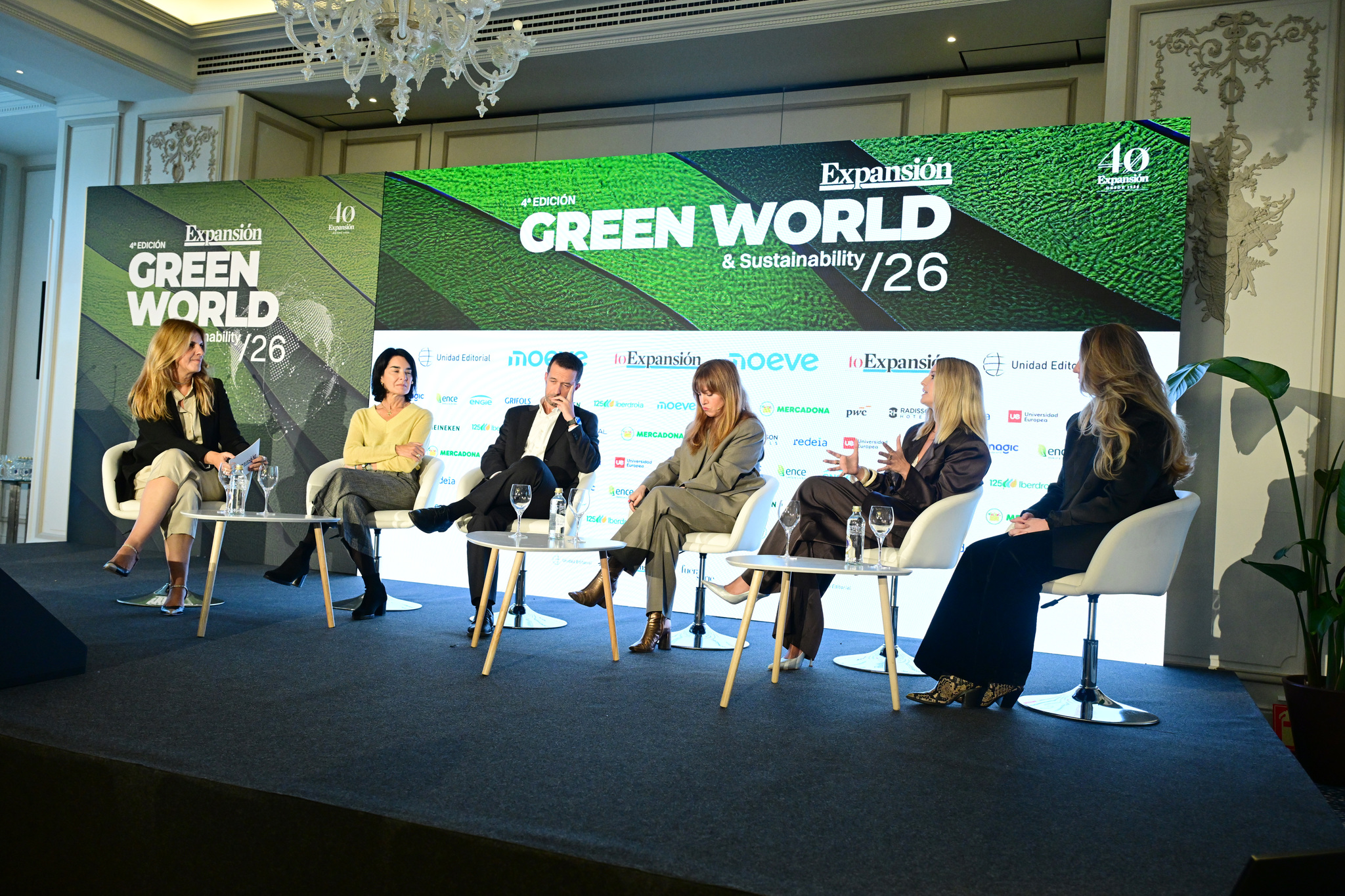
Executives from major corporations such as Heineken, Grifols, L'Oréal, Siemens, and the European University discussed the benefits and challenges of industrial transformation at the IV Green World and Sustainability Forum 2026, a conference sponsored by Moeve, Airmagic, Ence, Engie, Grifols, Heineken, Iberdrola, L'Oréal, PwC, Radisson Hotels, Redeia, the European University, and Veolia.
Heineken's Spain-based division plans to meet the multinational's 2030 sustainability targets by the end of 2025, with its beers and summer sodas made entirely from renewable energy. The decarbonization process has involved incorporating state-of-the-art systems developed with various partners, such as solar thermal technology for beer production.
Heineken's director of corporate affairs and sustainability, Carmen Ponce, noted that achieving this transformation has been challenging while maintaining the company's competitiveness. Grifols, a hemodervived manufacturing company, highlighted that reducing energy costs, waste, and water control have been key to enhancing its competitiveness.
The pharmaceutical sector faces the challenge of balancing sustainability with product quality to avoid impacting patient outcomes. Grifols analyzes the carbon footprint of all its suppliers and the company's value chain, as well as internal processes. L'Oréal's sustainability strategy combines science and industrial scale, as explained by its director of sustainability and positive impact in Spain and Portugal, Delia García.
The beauty industry giant blends researchers' efforts to improve products and processes with plants already using 100% renewable energy, ensuring that sustainability does not become a cost but rather a source of efficiency. L'Oréal also considers refillable formats as a win-win solution, using 60% to 80% less plastic and being 15% to 20% cheaper.
Siemens and the European University, partners in the decarbonization process, advise companies to analyze their starting point, use digital twins to simulate scenarios, and choose appropriate technologies based on data insights. Meanwhile, the European University's sustainability director, Maxine Kaisin, focuses on training professionals to contribute to the change and create solutions, collaborating with companies by presenting their sustainability challenges to students who then develop potential solutions. Throughout the year, the university works on a minimum viable product to address these challenges.
Written by urgent.news from Expansion ES's reporting — not their text. Machine-written — may contain errors; check the original before relying on it.