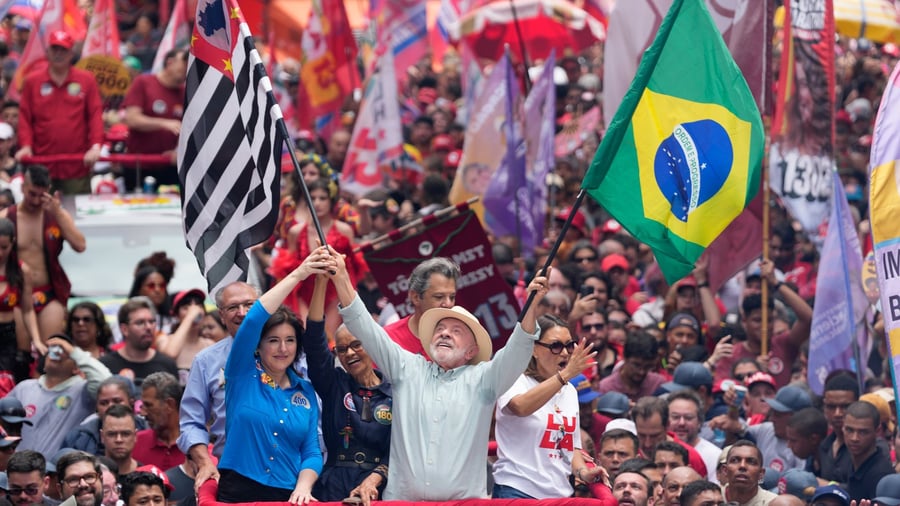
EDITORIAL. Sem margem de manobra
É difícil explicar para as pessoas não versadas no funcionamento da economia as diversas implicações da reeleição que o Presidente Lula conquistou ontem. Mas o mais assustador é que talvez ele mesmo não as compreenda.
The recent re-election of President Lula carries significant implications that many, even those familiar with economic operations, may not fully grasp. Over the past two decades, with only occasional exceptions, the Brazilian state has become increasingly spendthrift, with each president leaving the public debt burden greater than the previous one in relation to the nation's GDP.
This trend has led to consistently high interest rates, stifling credit availability for entrepreneurs, job creation, and general consumption. To finance this growing expenditure, successive PT governments have raised taxes, further burdening businesses.
Over these two decades, and with the accompanying institutional deterioration, capital has grown weary of being mistreated and began to withdraw from Brazil, both gradually and abruptly. Wealthy families have been allocating an increasing portion of their assets to foreign stocks and shares, rather than Brazilian companies. Meanwhile, our economy has lost relevance and dynamism compared to other nations.
For many multinational corporations and global investors, Brazil is still a significant market, but it has ceased to be "the country of the future."
It is essential to implement a drastic change in direction, a new approach, and the defeated candidate's supporters placed their hopes in Lula's defeated candidacy. At 81 years old, Lula shows no signs of understanding this reality or the societal desire for organized public accounts that could lead to lower interest rates at a reasonable level.
At his palaces, he has always claimed to have learned from his mother that one should not spend more than one earns, but after his first term, he never put this learning into practice. This time, he will not have the benefit of doubt, and markets will react dramatically to his victory. The prospect of maintaining the debt escalation is all that remains for capital still present – which had some hope – to fold its hands.
No one wants to wait for four more years for a government capable of delivering acceptable interest rates, not to mention the numerous other problems Lula 3 left for Lula 4 to resolve. Perhaps the magnitude of the impending crisis will convince the President to take action, and perhaps he will do so, but it is very likely to be an ill-conceived and shallow adjustment.
Lula claimed yesterday that he wants to create a "civilized" country, but there is nothing more barbaric than a 14% interest rate, now with upside bias, which will wipe out thousands of other businesses, and a dollar tending to R$6, which will raise inflation and further erode the purchasing power of Brazilians. After yesterday's election, Lula may have more political capital, but he has zero room for maneuver.
His next mandate will begin amidst multiple crises: a political one (with an opposition that does not recognize the election result), an institutional one (given the next Senate will have a vast conservative majority), and an economic one, whose first chapter we will witness today on Bloomberg screens. Markets will determine today the value of Brazilian companies, currency, and credit – and these prices will determine whether Brazilians, in Lula 4, will have more or fewer jobs, higher or lower salaries, and greater or lesser happiness. The President's constituents celebrate having, once again, saved democracy – but at what cost?
Written by urgent.news from Brazil Journal's reporting — not their text. Machine-written — may contain errors; check the original before relying on it.