Beyond transactions: How PhonePe and Razorpay are using AI to improve digital payments
At TechSparks 2026, Deep Agrawal of PhonePe and Khilan Haria of Razorpay discussed how contextual payments and AI can improve customer experiences, make financial services more accessible, and help small businesses grow.
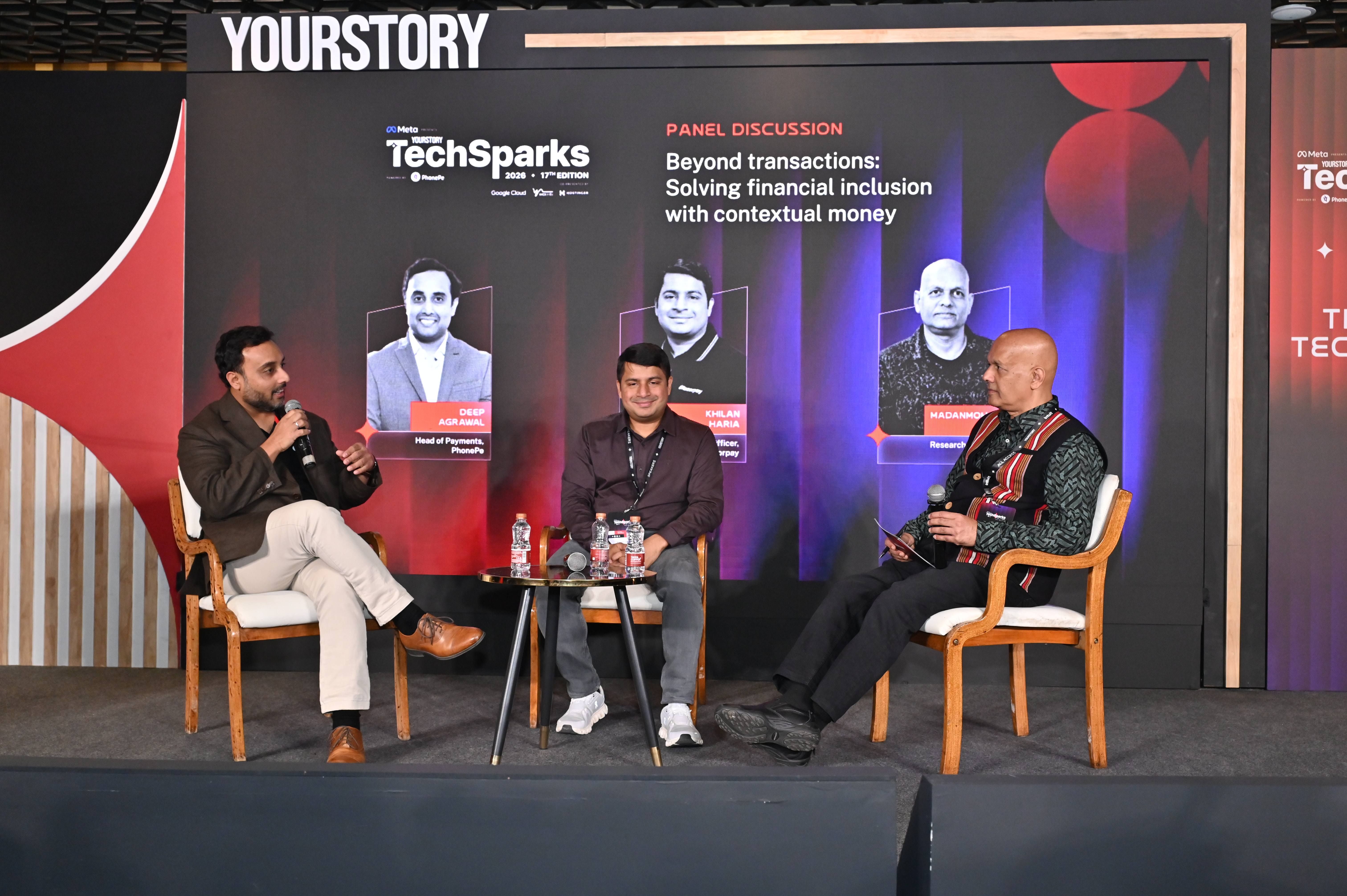
India has revolutionized digital payments, enabling transactions through QR codes. The next frontier involves leveraging payments to connect consumers with relevant financial products and assist businesses grappling with the complexities of expanding their online reach. At TechSparks 2026, Deep Agrawal, Head of Payments at PhonePe, and Khilan Haria, Chief Product Officer at Razorpay, joined Madanmohan Rao, Research Director at YourStory, for a panel discussion titled 'Beyond transactions: Solving financial inclusion with contextual money'.
The conversation explored how payments are evolving into a broader digital experience, ranging from enhancing transaction success rates to aiding merchants in attracting and retaining clientele. Beyond payments, what do users and businesses need? Agrawal highlighted that while more than 500 million UPI users rely on digital payments for personal transactions, bill payments, online shopping, and in-store purchases, the next challenge is integrating another 500 million people into the digital payments system while providing existing users access to financial products beyond mere payments.
For businesses, accepting payments is merely the initial step. Haria explained that Razorpay's experience with thousands of small and medium businesses has revealed that merchants face several hurdles once they have established payment infrastructure. These challenges include attracting customers, boosting conversions, and fostering repeat purchases.
"Over the years, we've learned as we've worked with millions of these SMBs. The larger problem sometimes goes beyond payments. Payments is what I now call the core infrastructure that SMBs need to establish their digital commerce or online business. However, beyond that, the struggle most businesses face is 'how do I get demand?
How do I maximize retention? How do I uplift conversion?'", Haria emphasized. Razorpay employs transaction data to refine payments and improve user experiences. Haria discussed Razorpay's transaction-led foundation model, Vulcan 5.2, which interprets the 'language of payments'. Every transaction contains nearly 3,000 attributes, and by analyzing these, the model can predict missing data, gauge fraud likelihood, and determine transaction conversion probability.
This empowers businesses to detect dubious transactions, mitigate risks, and enhance the chances of converting potential buyers into paying customers. Haria explained that while machine learning traditionally involves pattern identification, hypothesis development, and model training, transformer-based models can uncover intricate patterns difficult to detect through traditional techniques.
At PhonePe, machine learning enhances payment reliability. Agrawal introduced an internal model, 'Kill Switch', which forecasts transaction success based on factors like bank response times and recent transaction success rates. "Consumers don't care if a transaction fails. What they care about is it should not go into a pending state," Agrawal stated.
"In this model, we inform the customer ahead of time that your bank might be down; try again later." Agrawal noted that this approach fosters trust and compels users to return to the platform. Transaction context also aids payment platforms in recommending financial products tailored to customer needs. For instance, a customer booking an international flight through PhonePe might receive a travel insurance recommendation, while a user booking a bus within India may be suggested bus services.
Agrawal affirmed that PhonePe utilizes safeguards to ensure recommendations align with individual customers' preferences. Razorpay: From AI assistants to autonomous agents Razorpay is also harnessing AI to aid merchants in managing everyday business operations. Haria detailed two initiatives, Ray and Agent Studio, aimed at delivering accessible business support and automation.
Ray operates as an AI assistant serving as an account manager for businesses. While larger customers typically have dedicated account managers, scaling similar support to smaller merchants has been challenging. Ray enables merchants to articulate their issues via WhatsApp voice notes or plain English messages, bypassing complex dashboards and consoles.
Agent Studio takes this a step further by enabling businesses to deploy autonomous AI agents for specific tasks, such as recovering abandoned shopping carts, mediating disputes, confirming cash-on-delivery orders, and verifying delivery addresses. Haria revealed that Razorpay currently operates 12 agents, with 600 brands utilizing them, including some employing multiple agents.
The company aims to expand the number of agents to 100 within the next six months and eventually reach 100,000 businesses using these agents. PhonePe: Bringing more users into digital payments Agrawal also addressed how AI-driven tools could facilitate entry into the digital payments ecosystem for more individuals. He pointed out the obstacles faced by feature-phone users, many of whom reside in smaller towns, rural areas, or are just beginning to participate in the formal economy.
Feature phones have several constraints, including limited functionality and lack of internet access. Agrawal noted that PhonePe is exploring ways to incorporate features tailored to feature-phone users, aiming to broaden the digital payments landscape beyond smartphone users.
Written by urgent.news from YourStory's reporting — not their text. Machine-written — may contain errors; check the original before relying on it.