A child of Japanese incarceration’s call to arms: ‘The lessons of Manzanar have never been more urgent’
How a rebuilt, historic California baseball diamond embodies ‘the contradictions in America’s legacy’ When Dan Kwong first dreamed of staging baseball games at the Japanese American concentration camp where his family was held captive during the second world war , he thought of it as an exercise in living history, an eye-catching way to convey the trauma of 120,000 men, women and children who…
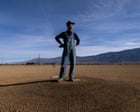
A rebuilt, historic baseball diamond in California embodies the contradictions present in America's legacy, according to Dan Kwong, a 71-year-old performance artist from Los Angeles. Kwong's project celebrates the spirit of resistance and loyalty of Japanese American internees during World War II, as they played baseball not only as a distraction but also as a way to express their commitment to the United States.
The recent event at Manzanar, a former Japanese American concentration camp in California's eastern Sierra mountains, drew hundreds of people who watched a double-header featuring players from the Japanese American baseball league. The players wore 1940s-era baseball uniforms, gloves, and catcher's helmets, and struggled to play on the unusual grassless field.
Kwong, who moved with the athleticism of a much younger man, took the field himself, first for his team, the Li’l Tokio Giants, and then in an all-star game pitting southern California against the north. Kwong used the event to highlight the racial animus of the 1940s and its revival in modern times, drawing connections between Donald Trump's "Make America Great Again" movement and the treatment of different groups of immigrants and citizens of color throughout history.
Ann Burroughs, the CEO of the Japanese American National Museum, echoed Kwong's sentiments, stating that the urgency of learning from Manzanar's lessons has never been more pressing. Actors in 1940s clothing appeared on the field carrying suitcases, symbolizing the arrival of Japanese immigrants in 1942, while a singer named Nobuko Miyamoto performed a plaintive song about the despair of the Manzanar prisoners.
Among the spectators were several men in their 90s who had been held captive at Manzanar as children. One of them, Masayoshi Morioka, vowed to be present for the last time in his lifetime, seeing the project as a powerful reminder of the past and an urgent call to action.
Written by urgent.news from The Guardian US's reporting — not their text. Machine-written — may contain errors; check the original before relying on it.