NCERT Introduces 20-Hour AI Module For Classes 9 To 12; Deepfakes, Data Privacy And Ethical Use In Focus
The National Council of Educational Research and Training (NCERT) has released a 20-hour introductory module on computational thinking (CT) and artificial intelligence (AI) for students of Classes 9 to 12. The activity-based module aims to help students understand how AI works, identify deepfakes, protect personal information and use AI tools responsibly. Developed by faculty members from the…
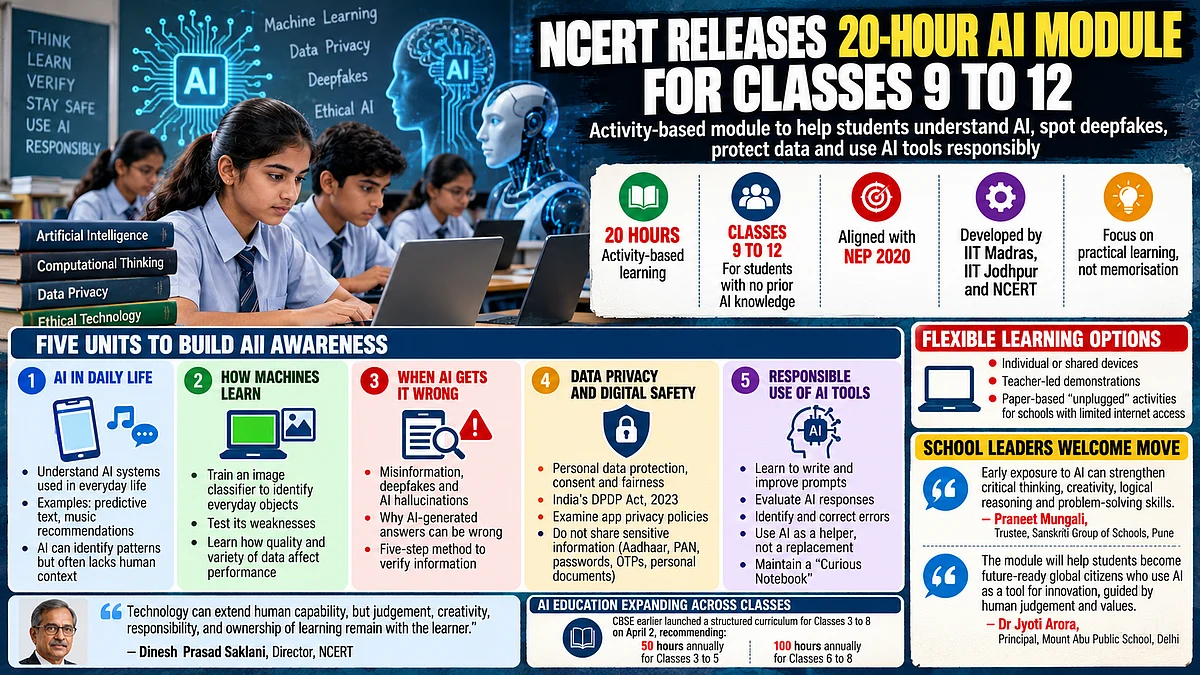
The National Council of Educational Research and Training (NCERT) has launched a 20-hour introductory module on computational thinking (CT) and artificial intelligence (AI) for students in Classes 9 to 12. The hands-on module aims to familiarize students with the workings of AI, teach them how to identify deepfakes, protect personal information, and use AI tools responsibly.
Developed by faculty members from IIT Madras, IIT Jodhpur and NCERT, the curriculum aligns with the National Education Policy (NEP) 2020. Designed for students without prior knowledge of AI, the module emphasizes practical learning rather than memorizing technical concepts. A proactive move towards preparing students for an era where AI increasingly permeates daily life, the initiative is set to equip young learners with essential skills.
The curriculum is divided into five units, addressing AI's presence in daily life, machine learning, AI errors, data privacy, and responsible usage of modern AI tools. Students learn about AI-powered applications, the reason behind occasional incorrect outputs, and methods to validate their responses. The first unit introduces AI systems commonly encountered, like smartphone keyboards predicting words or music recommendation apps.
By showcasing pattern recognition via relatable examples, students grasp that AI can identify patterns but often lacks the contextual understanding inherent in human cognition. The second unit explains how machines learn through examples. Students engage in training an image classifier to recognize everyday objects, deliberately testing its limitations.
Through this exercise, learners understand how the quality and diversity of training data impact an AI system's performance. The third unit, titled "When AI Gets It Wrong," examines misinformation, deepfakes, and AI hallucinations. Students explore why AI-generated answers can appear convincing even when false and learn a five-step process to verify information before trusting or disseminating it.
This skill becomes critical as students frequently interact with AI-generated content online. Data privacy and digital safety are acknowledged in the fourth unit, which introduces personal data protection, consent, fairness, and digital safety. Students learn about India's Digital Personal Data Protection (DPDP) Act 2023 and scrutinize the privacy policies of applications they use.
The module warns against sharing sensitive information, such as Aadhaar and PAN numbers, passwords, one-time passwords, and personal documents, with AI tools. This early lesson in digital safety is expected to foster responsible digital habits before students engage extensively with AI tools. The fifth and final unit focuses on utilizing AI tools effectively without becoming overly dependent on them.
Students will master writing and refining prompts, evaluating AI-generated responses, and recognizing errors necessitating correction. By promoting a "helper-stance," the module encourages students to employ AI to enhance their work while retaining accountability for their own thinking. Students will maintain a "Curious Notebook" to document their observations, reasoning, and reflections throughout the five units.
This approach emphasizes experimentation and learning from mistakes rather than solely relying on classroom lectures. The module development team asserts, "This is not a module to be memorized. It is a set of habits to be practiced." The suggested teaching schedule spans 20 classroom hours and provides three methods for conducting activities: using individual or shared devices, participating in teacher-led demonstrations on a common screen, or engaging in paper-based exercises and classroom discussions.
Flexible learning caters to schools with limited computer or internet access, enabling core activities through "unplugged" learning. School principals, including those from Sanskriti Group of Schools in Pune and Mount Abu Public School in Delhi, have warmly welcomed the introduction of the module. They see teaching AI concepts from Class 9 as crucial for equipping students with the skills necessary in a technology-driven world.
Prominent figures like Praneet Mungali and Dr Jyoti Arora emphasize that early exposure to AI cultivates critical thinking, creativity, logical reasoning, and problem-solving abilities while ensuring students understand both AI's potential and limitations. NCERT director Dinesh Prasad Saklani echoed these sentiments in a press release, reiterating the importance of maintaining human judgment as the cornerstone of learning.
The module stresses that "technology can extend human capabilities, but human judgement, creativity, and ethical responsibility remain central to learning."
Written by urgent.news from Free Press Journal's reporting — not their text. Machine-written — may contain errors; check the original before relying on it.
This story
This is one outlet's version. Read the fullest account.
- NCERT releases AI module for Classes 9 to 12; deepfakes, ethical usage in focus hindustantimes.com
- NCERT AI module for Classes 9 to 12: Key features and learning details indianexpress.com