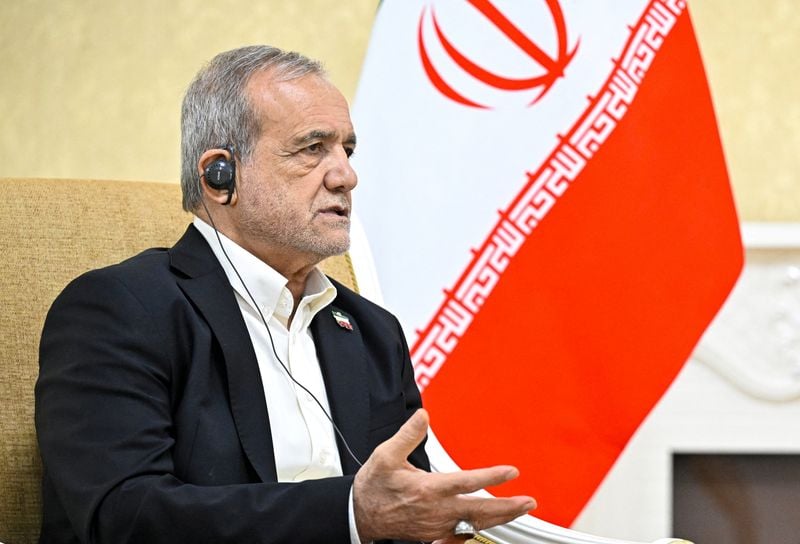
Iran’s Pezeshkian blames US for interim deal failure, urges new try
ISLAMABAD (AP) — Iran is willing to engage in discussions with the United States under a Pakistan-mediated interim agreement aimed at resolving the dispute over the Strait of Hormuz, Tehran's ambassador to Islamabad stated on Saturday. The ambassador, Reza Amiri Moghadam, accused the U.S. of obstructing diplomacy and prolonging the crisis, which has centered on the Strait of Hormuz.
Iran recently suggested through Pakistan that it would consider reopening the strait if the U.S. lifted its naval blockade, but cited President Donald Trump's refusal to do so as a reason for Iran's reluctance. The June accord, brokered by Pakistan and Qatar, aimed to restore shipping through the strait and eliminate the U.S. naval blockade while paving the way for broader negotiations on Iran's nuclear program.
Moghadam, during a seminar in Islamabad, said Iranian officials had expressed their readiness to reopen the strait during meetings with Pakistan's Army Chief, Field Marshal Asim Munir, if Washington ended its blockade. He also mentioned that Tehran would review the Mecca Joint Defense Agreement, which involves Pakistan, Saudi Arabia, and Turkey, before determining whether to endorse it, describing it as a possible tool for unity.
Written by urgent.news from Winnipeg Free Press's reporting — not their text. Machine-written — may contain errors; check the original before relying on it.
This story
This is one outlet's version. Read the fullest account.
- Iran remains open to talks with US under Pakistan-brokered deal, envoy says winnipegfreepress.com
- US wants regime change in Iran, not nuclear deal: Expert gulfnews.com
- Iran blames US for collapse of interim deal, urges renewed talks english.ajel.sa
- Iran's Pezeshkian blames US for interim deal failure, urges new try al-monitor.com
- Iran's Pezeshkian blames US for interim deal failure, urges new try brecorder.com