The Center Cannot Hold at the Toronto Biennial
It’s a provocative and discursive exploration of how artists respond to our late-capitalist epoch, but its focus on “rupture” raises questions.
Canadian Prime Minister Mark Carney recently likened the world to being "in the midst of a rupture, not a transition" during the World Economic Forum in Davos, Switzerland. This sentiment also serves as the epigraph for the fourth Toronto Biennial of Art, "Things Fall Apart," curated by Allison Glenn. The exhibition brings together over 30 artists and collectives from Toronto and beyond, including Anchorage in Alaska and Times Square in New York.
Glenn's focus on water, specifically the Great Lakes, serves as a starting point to explore how artists working with rupture can teach us about history, borders, and movement. With Canada–United States relations at an all-time low, a cross-border exhibition built around shared waterways feels appropriate.
At the Art Gallery of Ontario (AGO), Dawoud Bey's "Material Histories, Living Landscapes" features photographs from his three landscape series and sculptures and ritual objects from Nigeria, Ghana, and the Kingdom of Kongo. The pairing highlights the enduring impact of the afterlife of slavery on the physical world around us.
Antonio Obá's installation "Jardim" at the University of Toronto Art Centre consists of brass bells arranged in rows along a gallery, activated by visitors' movement. This piece invites viewers to reenact memories rather than store them as unchanging artifacts. The path leads to "A Folia: travessia" (2026), a painting that reimagines the 1957 photograph of Dorothy Counts integrating a high school in Charlotte, North Carolina, replacing the hostile crowd with a supportive march and New Orleans-style street carnival.
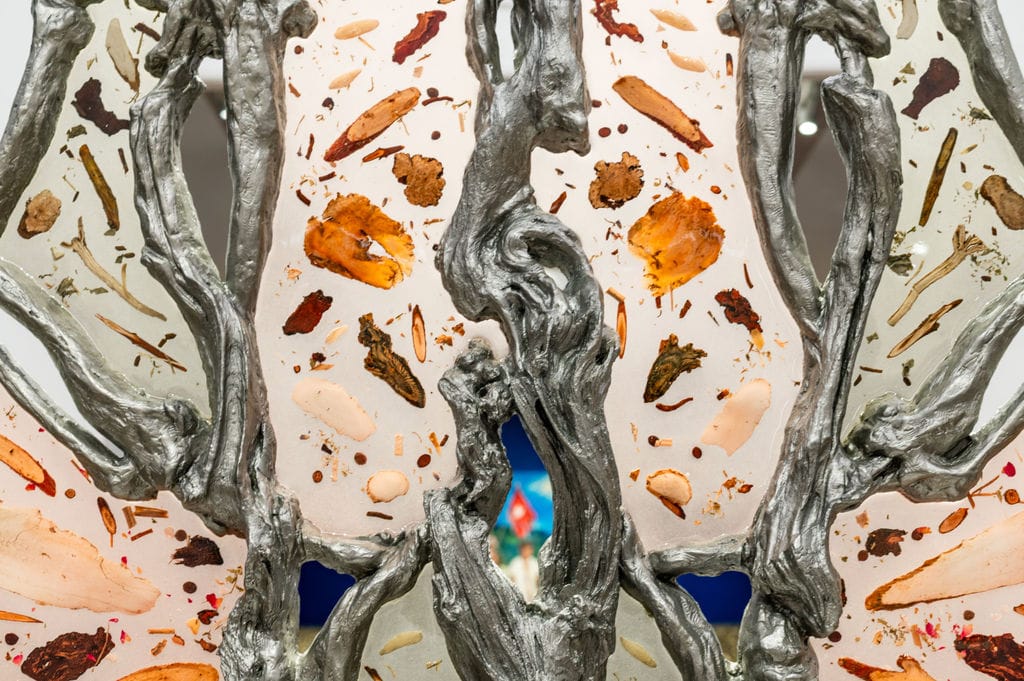
Wen Liu's "In Light, Where Edges Yield" (2025) incorporates Chinese herbal medicines prescribed to the artist after her father's death, suspended from a steel-and-resin sculpture built around her spinal column. This work emphasizes the body as a source of familial and personal knowledge that can guide us through difficult periods.
Taqralik Partridge's "umiakkut (by boat)" (2026) revisits her grandmother's journey across the Hudson Strait in an umiaq boat, using found materials, sewing, and beadwork to create a mirrored vessel and soundscapes of water, passing on intergenerational knowledge in the face of ecological devastation.
Written by urgent.news from Hyperallergic's reporting — not their text. Machine-written — may contain errors; check the original before relying on it.