Tech selloff slows in Asia, oil hits five-month high
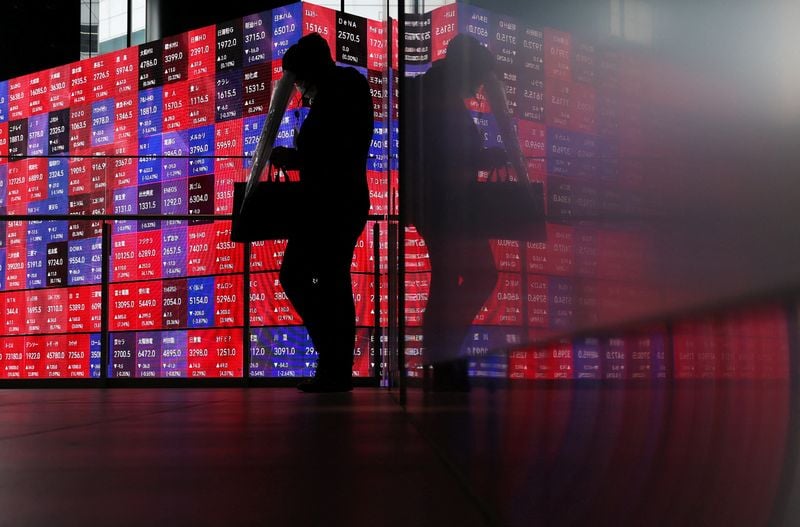
A selloff in global tech shares lost some steam in Asia on Friday, following concerns over the enormous funding needs of AI, which impacted Wall Street and led to the biggest daily rally in Treasuries in more than three years. European bourses were expected to begin trading steadily, with pan-region stock futures remaining relatively unchanged.
Nasdaq futures declined by 0.1%, while S&P 500 futures slipped by 0.2%. However, Brent crude added 0.9% to reach a five-month high of $114.10 a barrel due to growing fears that the conflict in the Middle East might intensify. Brent was set to conclude the week with a 3.9% increase after Houthi attacks in Saudi Arabia heightened worries about potential further disruptions to energy supplies.
Treasuries maintained their gains from the previous night amid the safety-seeking trend. Market players reduced expectations of further policy tightening from the Federal Reserve, eliminating nearly a full quarter-point rate hike for the coming year, as fears emerged that the bursting AI bubble could disrupt the data-center investment boom and weaken the US economy.
A December rate increase was no longer fully anticipated, with the probability dropping to 85%. MSCI’s extensive Asia-Pacific shares index, excluding Japan, was flat after initially sliding as much as 0.8% following a significant selloff. Nevertheless, it was anticipated to experience a weekly loss of 2.4%, marking the fourth consecutive week of decline.
Japan's Nikkei fell 0.5% and nosedived by 4.1% throughout the week. South Korea's KOSPI managed a 0.1% gain after dropping 4% earlier in the session. Mainland China's blue-chips received support after plummeting to the lowest level since July 2025; the CSI300 increased by 0.8%. Hong Kong's Hang Seng also rose 0.7% after declining 3% on Thursday.
While it is premature to view equities as overly bearish, the AI trade is evolving. The AI trade is no longer merely about 'buying everything'. On Wall Street, the Nasdaq plummeted by more than 2%, with Meta shares experiencing an 8% drop after the social media giant disclosed its inaugural cash outflow in over a decade due to AI-related expenses.
Meta also announced plans to issue non-voting shares via a two-for-one split to generate capital for investing in the technology. Tesla shares fell by 3.1% as the electric vehicle manufacturer reduced its 2026 capital spending projections. As tech stocks plummeted, investors gravitated towards US Treasuries, creating a flight to safety, thereby driving yields down across the yield curve.
The benchmark 10-year Treasury yield fell more than 19 basis points, the largest decrease since March 2023, before stabilizing at 4.9676% on Friday, back below the widely watched 5% threshold. This shift in yields was also attributed to the persistent sell-off in French bonds, where the benchmark yield increased by 6 basis points overnight to 5.0601%, the highest level since 2002.
The US 10-year yield bottomed below 5% with considerable conviction. Padhraic Garvey, ING’s regional head of research for the Americas, expressed caution, stating, "We’re not convinced it continues, as we still have inflation/fiscal deficit/AI boom factors to consider, and we have the US midterm elections approaching as a potential source of trouble.
However, it will require some level of calm in the risk space before it happens." Treasury yields on the 2-year declined by nearly 19 basis points overnight and were presently flat at 4.6582%. Government bonds in Asia also rallied, with the yield on 10-year Japanese government bonds decreasing by 9 basis points to 2.780%, and Australia’s 10-year yield falling by 8 basis points to 5.178%.
In the currency markets, the dollar steadied at 156.91 yen on Friday, after declining 0.9% the night before. The dollar gained 0.2% to 0.8219 Swiss franc after an overnight fall of 0.5%. Gold remained flat at $4,021.99 an ounce on Friday, despite a nearly 3% drop the previous day.
Written by urgent.news from Investing.com's reporting — not their text. Machine-written — may contain errors; check the original before relying on it.