Magnetic Field Reversals and Extinctions: The Correlation Won't Go Away.
Scientists have wondered about a connection between Earth's geomagnetic reversals, or pole flips, and mass extinctions. They've found correlations, but nothing convincing enough to remove healthy doubts. But new research found a period of time with a concentrated number of reversals that coincides with and extinction and Large Igneous Provinces. It's likely not definitive proof, but it's…
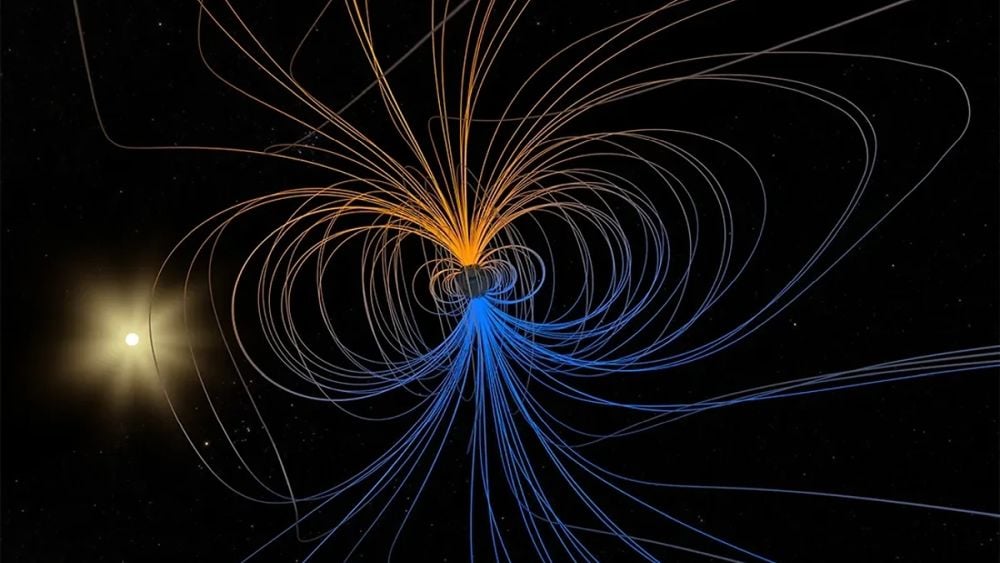
Earth's magnetic field has experienced numerous flips throughout its 4.5 billion year history, a phenomenon known as geomagnetic reversals. Scientists have long studied these reversals, which are detected through paleomagnetism, the study of the orientation of Earth's poles across geological time in lava and sediments. Despite extensive research, no definitive link has been established between geomagnetic reversals and extinctions.
The geomagnetic field has been known to flip about once every 450,000 years, with evidence of 183 reversals in the last 83 million years. However, the average does not indicate a periodic cycle, making it challenging to predict when a reversal will occur. The last reversal happened around 780,000 years ago, suggesting we might be overdue for the next one.
In a recent study, researchers from the Chinese Academy of Sciences found evidence of a period of geomagnetic chaos during the Permian period that may be linked to an extinction event. The Permian witnessed significant geomagnetic, environmental, and biotic upheavals, with the researchers presenting a magnetostratigraphic record from South China that covers 3.75 million years.
This record shows extreme geomagnetic instability, characterized by 29 magnetozones and an unprecedented reversal frequency of 11 reversals per million years, one of the highest records in Earth's history. This period of instability was temporally correlated with the end-Guadalupian extinction, approximately 261 million years ago.
The authors suggest that geomagnetic instability may have contributed to surface ecosystem collapse, although the causation remains unproven. The researchers also note that the appearance of Large Igneous Provinces (LIPs) coincided with the extinction event and geomagnetic reversals. LIPs are associated with mantle plumes and are linked to extinctions and rapid climate changes.
The weakening of Earth's magnetic shield during reversals could potentially lead to increased radiation and ozone depletion, but this idea remains unproven. The researchers emphasize that the correlation between these factors warrants further investigation.
Written by urgent.news from Universe Today's reporting — not their text. Machine-written — may contain errors; check the original before relying on it.