Historisches Gedenken: Ungarn feiert Aufstand 1956 - und den politischen Umbruch
Der Aufstand der Ungarn im Jahr 1956 wurde blutig niedergeschlagen. Die Erinnerung daran war jahrzehntelang tabuisiert. 70 Jahre danach stehen die Feiern auch im Zeichen eines politischen Umbruchs.
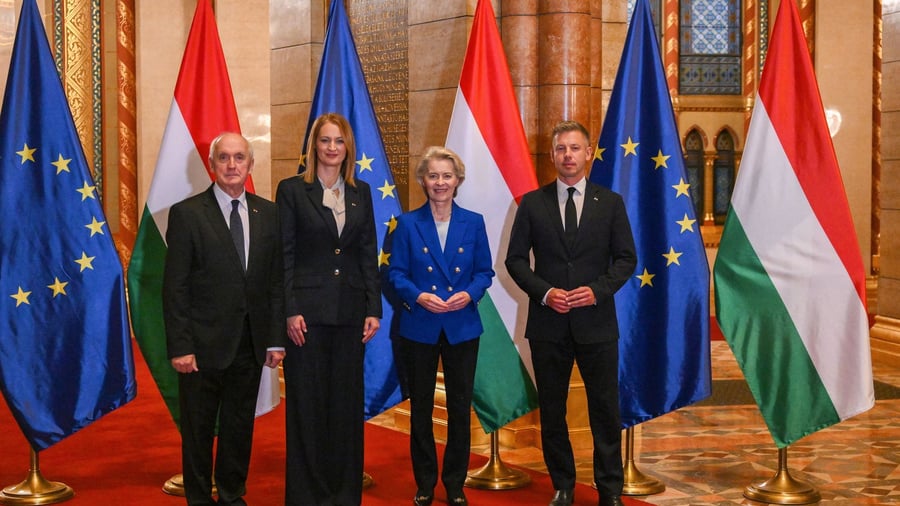
The Hungarian government has commemorated the 70th anniversary of the 1956 revolution against communist rule, which began on October 23rd and was brutally suppressed by Soviet troops twelve days later on November 4th. The festivities were marked by a shift in government following the defeat of right-wing Prime Minister Viktor Orban in April of this year.
New Prime Minister Peter Magyar emphasized in his speech at the Kossuth Square that those who excuse aggressors after 1956 or subordinate the people to the interests of a foreign empire have not understood the message of 1956. Hungary, a member of the free, democratic West, aims to be a reliable partner in the region, he added. European Commission President Ursula von der Leyen praised the Hungarian spirit of freedom displayed in 1956 and stressed that democracy must be continually fought for.
This year, Hungary has "reborn democracy," she said in her speech at the Parliament, reflecting on Magyar's election victory. Among the guests were European Council President António Costa and Berlin's Transport Minister Steffen Bilder, representing Chancellor Friedrich Merz. Among the attendees was also the President of the European Council.
Hungary, like other Eastern European countries and East Germany, fell under the Soviet sphere of influence after World War II. After 1945, a communist dictatorship gradually emerged under Soviet military occupation, banning parties, executing or imprisoning critics in show trials, seizing property from the bourgeoisie and sending them to internment camps.
Soviet dictator Joseph Stalin died in 1953, but Stalinism did not end in Hungary. Growing discontent among the population, even among communists, led to the death of Stalin's statue on October 23rd as thousands gathered on the Kossuth Square to demand change. Following a shooting of peaceful protesters by state security forces on October 25th, the revolutionaries began to arm themselves, as the Hungarian army largely sided with the uprising.
Stalinists within the Communist Party abandoned their positions, and Imre Nagy, a popular but previously cold reform communist, took over the government. They proclaimed democratic socialism with freedom of the press, assembly, and religion, and legal political parties. Political prisoners were released, and spontaneous acts of violence against communists and secret service agents occurred.
Hungary did not initially join the Warsaw Pact, but the Soviets eventually intervened with massive troop reinforcements. On November 1st, Nagy fled and declared Hungary's withdrawal from the Soviet-led military alliance. On November 4th, Soviet troops brutally suppressed the Hungarian uprising in street battles. To restore the dictatorship, the Soviets installed the communist official Janos Kadar, who unleashed a merciless revenge justice.
Over 200 revolution participants, including Nagy and his closest associates, were executed after standing trials. 22,000 people often spent long years in prison. 200,000 Hungarians fled over Austria to the West. With the original hardliner Kadar softening his stance over time, the slogan "Gulaszkommunismus" became a common phrase.
However, the taboos remained: discussing 1956 was not allowed until the change years of 1989/90. It was not until June 16th, 1989, that the communists allowed the reburial of Nagy and his associates at the Budapest Heroes' Square. At this commemorative act, a young, then little-known student leader, Viktor Orban, delivered a speech marking the irreversible break with communism.
The 16 years of Viktor Orban saw him transform from a liberal to a conservative and then into a right-wing populist, ruling from 1998 to 2002 and again from 2010 to his defeat this spring. He used his power to build a semi-autocratic corruption regime. After 2014, as Orban increasingly aligned himself with Russia's Vladimir Putin, many saw it as a betrayal of the ideals of 1956.
The commemoration of 70 years later is often seen by many Hungarians as an expression of joy over the departure from the path to oppression that Orban initiated, even if it never reached the level of oppression seen in communism.
Written by urgent.news from Handelsblatt's reporting — not their text. Machine-written — may contain errors; check the original before relying on it.