Ask Ethan: Can we solve the mysteries of the largest black holes?
Out there in the Universe, there are some incredibly impressive astrophysical entities, including behemoths that dwarf anything we’re familiar with. There are stars hundreds of times more massive, and millions of times as luminous, as our own Sun is. There are galaxies and galaxy clusters thousands of times as massive as our Milky Way and Local Group. And there are black holes out there that not…
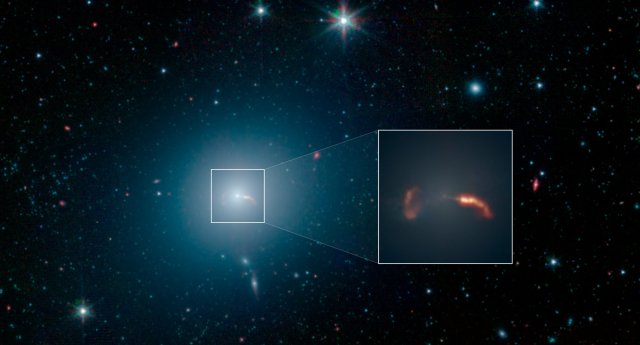
In the vast expanse of the Universe, there exist extraordinary astrophysical entities such as supermassive black holes. These cosmic behemoths dwarf the Sun in terms of mass and luminosity, and even exceed the combined mass of all stars in the Milky Way galaxy. Some of these colossal black holes even formed just a few billion years after the Big Bang, presenting a series of intriguing questions for researchers.
The largest known black hole, TON 618, has a mass of roughly 66 billion solar masses. Given its great distance of about 10.8 billion years, it appears as it was only 3 billion years after the Big Bang. This presents a puzzle - how could a black hole of such immense size have formed so rapidly, and why are the biggest ones observed at such great distances rather than closer to home?
To understand the formation of these massive black holes, we can look to a process called direct collapse. When a massive cloud of cold gas condenses within a few hundred million years post-Big Bang, it can lead to the direct collapse of a "seed" black hole several thousand solar masses in size. This process can occur even before stars begin to form within the nascent galaxy.
As the galaxy and the black hole continue to grow, the stellar mass content will eventually surpass the black hole itself. Dark matter, which cannot cool and condense like ordinary matter, cannot form a black hole in the same way.
The early theories of black hole formation in the 20th century focused more on their theoretical predictions than on empirical observations. However, the concept of black holes emerged from the work of John Michell in the 18th century and was further developed by Karl Schwarzschild in 1916. Schwarzschild's solution to Einstein's general relativity showed that if matter at rest in general relativity is released and allowed to gravitate, it will collapse to form a non-rotating black hole with an event horizon at a specific distance, known as the Schwarzschild radius.
This radius is determined by the mass of the black hole, and any additional mass that falls within this radius increases the black hole's mass.
Initially, black holes were theoretical concepts until the 1950s and 1960s when objects that resembled black holes began to be detected. Cygnus X-1, discovered in 1964 as an X-ray emitting source, was the first known black hole candidate within our Milky Way galaxy. Located near regions of intense star formation, Cygnus X-1 is believed to be an X-ray binary system, where the black hole accretes matter from its massive stellar companion, emitting X-rays from the heated, accelerated material surrounding it.
Written by urgent.news from Big Think's reporting — not their text. Machine-written — may contain errors; check the original before relying on it.
This story
This is one outlet's version. Read the fullest account.