Two Disks in One: How Accretion Disks Drive Black Hole Jets
SMBH jets are driven by thick, hot accretion disks with powerful magnetic fields. But there's a bit of a paradox. Some SMBH produce jets, even though they appear to have thin, cold accretion disks. New research has solved this paradox, showing that disks can be truncated into an outer cold disk and an inner hot disk.
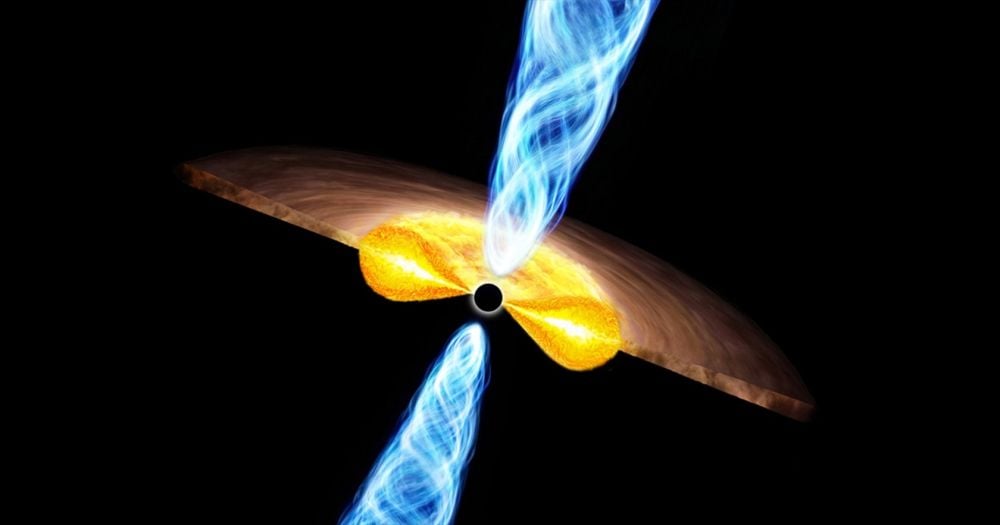
Astrophysicists have long been fascinated by the powerful jets emitted by supermassive black holes. These jets, composed of ionized gas, can stretch for millions of parsecs and travel at relativistic speeds. They can influence their host galaxy and even disrupt star formation in the galaxy's cluster. However, understanding how these jets are launched has proven to be a challenge.
This new research published in The Astrophysical Journal Letters investigates the connection between accretion disks and the launching of these jets.
The key to this process is the Blandford–Znajek (BZ) mechanism, which extracts energy from a spinning black hole through large-scale magnetic fields sustained by an accretion flow. There are two types of accretion disks: hot, thick disks and cold, thin disks. The BZ mechanism requires large-scale magnetic fields to launch jets, but thin, cold disks are typically incapable of sustaining these fields. Despite this apparent contradiction, cold disks still manage to launch jets.
To unravel this mystery, researchers utilized powerful X-ray and radio observations to study 3C 120, an active galaxy approximately 420 million light-years away. This galaxy is rapidly accreting material and emitting jets. By examining 3C 120 with state-of-the-art X-ray and radio telescopes, researchers were able to observe both the hot plasma surrounding the black hole and the jet emerging from it, providing a direct link between the extreme environment near the black hole and the formation of the jet.
Using advanced X-ray and radio observatories, the researchers discovered that the accretion disk around 3C 120 is truncated at about 20 times the black hole's radius. The outer portion of the disk consists of a cold, thin disk, while the inner region is a hot, thick flow. This two-part structure in the accretion disk allows for the launching of jets, even though the outer disk is insufficient to provide the necessary magnetic fields.
These findings demonstrate that jet launching is linked to a hot inner flow, possibly through the Blandford–Znajek process. This work provides a new method for observing supermassive black holes, their accretion disks, and the jets they launch. Applying this method to a larger sample of galaxies will help researchers gain further insights into the complex interactions between matter, magnetic fields, and black hole rotation in these extreme environments.
Written by urgent.news from Universe Today's reporting — not their text. Machine-written — may contain errors; check the original before relying on it.