Supermassive black holes ejected from galactic centers? Quasar survey supports decade-old prediction
By analyzing data on around 100,000 quasars, or extremely luminous galactic nuclei, researchers at Eötvös Loránd University (ELTE) have found statistical evidence that some supermassive black holes at the centers of galaxies are ejected from their positions after forming. The relationship now identified in the data was predicted 10 years ago by members of the same research group, Peter Raffai and…

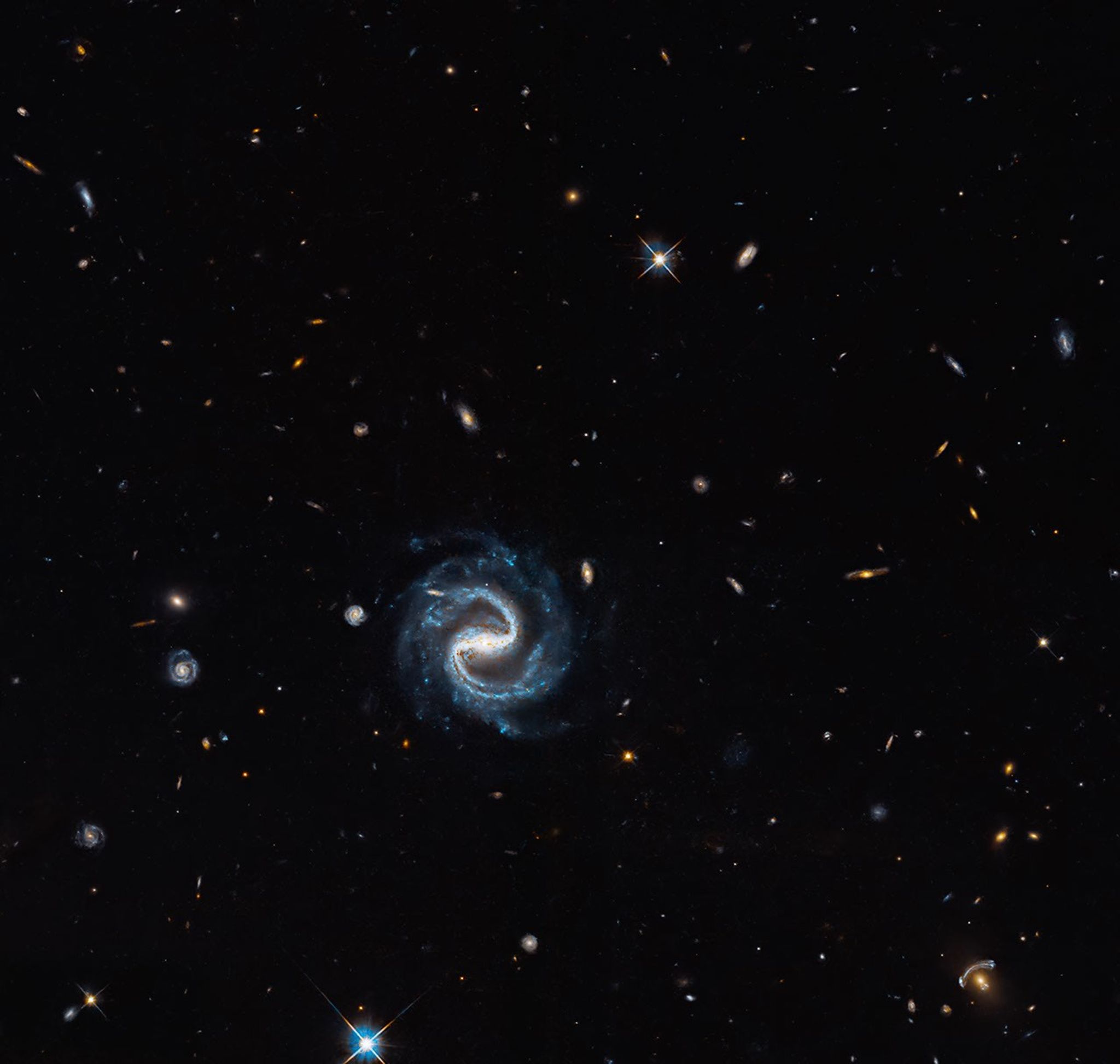
New evidence has emerged supporting the old prediction of recoiling supermassive black holes (SMBH). Supermassive black holes reside at the centers of large galaxies, and gravitational wave detectors have shown that these SMBHs merge when their galaxies collide. However, some SMBHs do not merge, and these are called recoiling SMBH.
Theoretical predictions suggest that if gravitational waves produced by the merger are uneven, it can cause the merger remnant SMBH to be kicked out of the galactic center with a powerful kick. This results in a pendulum-like oscillation of the SMBH across the galactic center.
A recent study titled "Statistical evidence for massive black hole recoils in active galactic nuclei" published in Monthly Notices of the Royal Astronomical Society examined the population of quasars, which are the brightest active galactic nuclei, to search for traces of recoiling SMBHs. Quasars are extremely luminous objects, making them easier to find and observe. The research team analyzed approximately 100,000 quasars from the 16th data release of the Sloan Digital Sky Survey.
Quasars emit light that contains critical information, including their velocity. As a recoiling SMBH oscillates, its velocity changes depending on the SMBH's position relative to the galactic center. The outer region of the accretion disc of gas around the SMBH moves with it, while the inner region lags behind, exhibiting a redshift consistent with the host galaxy and the dust torus at the galactic center. By comparing the light signals from both regions, researchers can determine the SMBH's speed.
Additionally, the study found a significant relationship between the dust obscuration in quasars and the SMBH's speed. The faster the recoiling SMBH moves, the more likely its quasar will be buried in dust. This is because dust extinction, which reddens the light of quasars, is thickest near the galactic center, where the remnant SMBH moves the fastest.
The research indicates that recoiling black holes would produce this result, but it does not definitively confirm that all observed objects are recoiling SMBHs. The findings suggest that LISA, a space observatory dedicated to detecting gravitational waves, should be able to detect recoiling SMBHs.
Written by urgent.news from Universe Today's reporting — not their text. Machine-written — may contain errors; check the original before relying on it.
This story
This is one outlet's version. Read the fullest account.
- New Evidence for an Old Prediction: Recoiling Supermassive Black Holes universetoday.com