Cassiopeia and Perseus on October evenings
Cassiopeia and Perseus are neighbors in the autumn sky. Use Cassiopeia's distinctive W or M shape to locate the dimmer Perseus on autumn and winter evenings. The post Cassiopeia and Perseus on October evenings first appeared on EarthSky .
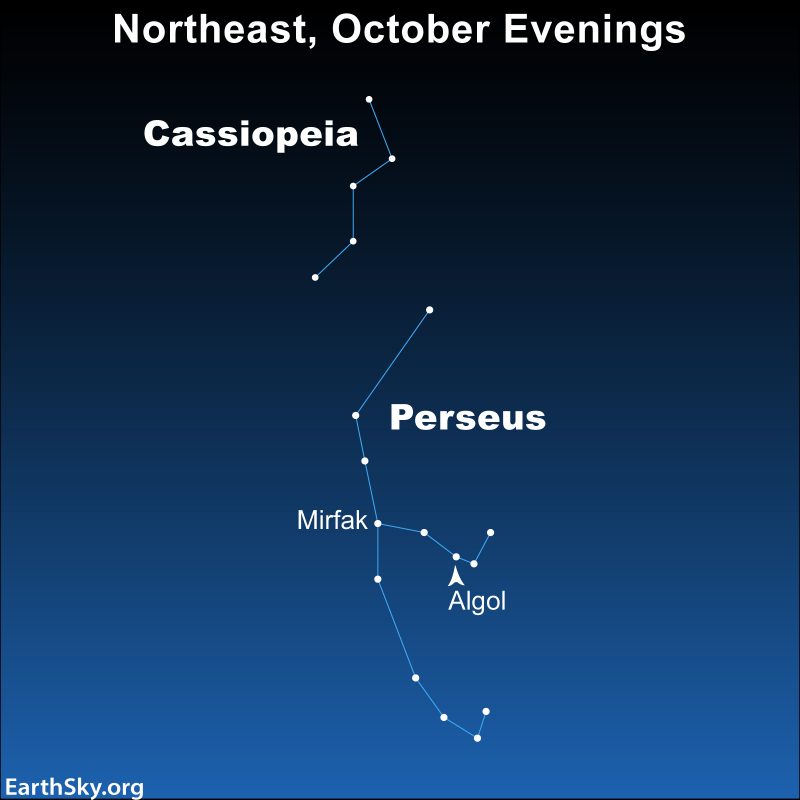
Cassiopeia and Perseus are prominent constellations that can be found in the northern sky during autumn evenings. Cassiopeia, known as the Queen, is easily recognizable with its distinctive M or W shape, while Perseus, the Hero, follows Cassiopeia across the sky. The star Algol, often referred to as the Ghoul Star or Demon Star, is located within Perseus and is particularly notable as it is a variable star.
These constellations can be spotted in the northeast on October evenings, becoming higher in the sky throughout the autumn and winter months. From about 40 degrees north latitude to farther north, both Cassiopeia and Perseus are circumpolar, meaning they never set below the horizon and instead circle around the North Star, Polaris.
The brightest star in Cassiopeia is Schedar, while the brightest star in Perseus is Mirfak. However, the star Algol in Perseus often receives more attention due to its variable brightness. The radiant of the famous Perseids meteor shower, which peaks around August 12 or 13, is located between Cassiopeia and Perseus. Tracing the paths of Perseid meteors backward reveals that they appear to originate from this point in the sky.
Between Cassiopeia and Perseus, you can find the magnificent Double Cluster in Perseus, which consists of two open clusters, NGC 884 and NGC 869. These clusters can be easily observed with the naked eye and are particularly beautiful through a telescope. Don't forget to scan between Cassiopeia and Perseus with binoculars, as the Double Cluster is a stunning sight that will impress your friends.
Written by urgent.news from EarthSky's reporting — not their text. Machine-written — may contain errors; check the original before relying on it.
This story
This is one outlet's version. Read the fullest account.