AI’s hidden storage bill: What inference leaves behind
Ask most executives to picture the cost of AI and they’ll likely see GPUs—racks of accelerators with gigawatts of power—and a waitlist for silicon. But that picture leaves something out: Data storage costs. What happens to data after a model responds? Much of the back-end data that’s generated—from billions of daily prompts, images, and videos—needs…
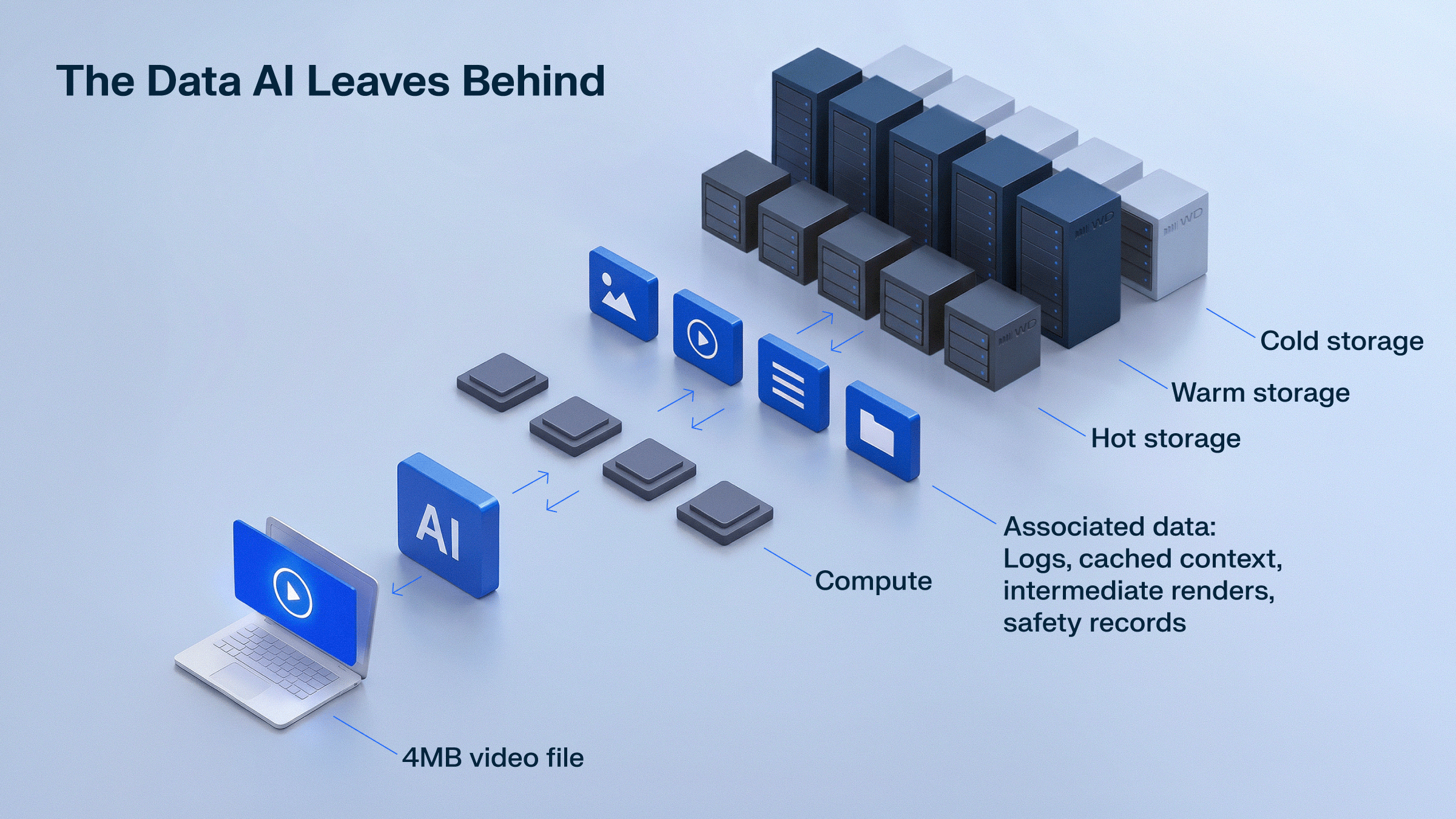
Most executives picture AI costs in terms of GPUs and silicon shortages, but they often overlook the hidden expense of data storage. After a model generates an answer, it creates a considerable amount of back-end data, including logs, cached context, and backups. This data footprint can be significantly larger than the actual output, growing at a faster rate than compute costs as AI inference scales.
For example, an 8-second AI-generated video can leave behind more than 500MB of associated data, a 130x increase over the 3.97MB output file. As AI inference demand grows at a 35% CAGR through 2030, compared to 22% for training, data storage costs will make up more than 40% of total data center demand by the end of the decade. A recent IDC survey found that nearly 95% of IT and business decision makers reported an increase in data volume due to generative AI, with roughly 61% experiencing growth of 25% or more.
This growing data volume poses a challenge for budgeting, as storage costs tend to be underestimated and can outpace compute budgets. To address this issue, organizations must rethink their AI infrastructure budgeting, considering both compute and storage costs. Storage strategy should be designed for the full AI data lifecycle, balancing performance with capacity, power, reliability, and total cost of ownership.
This involves treating archives as active assets for retrieval augmented generation (RAG) and setting retention policies that reflect the growing strategic value of the data, rather than its original storage cost.
Written by urgent.news from MIT Technology Review's reporting — not their text. Machine-written — may contain errors; check the original before relying on it.