Yes Bank AT1 Bonds: While RBI Failed Investors, Where Was SEBI?
The Supreme Court’s October 15 judgement, upholding the quashing of Yes Bank’s ₹8,415 crore Additional Tier 1 (AT1) bond write-off, raises a fundamental question of regulatory accountability: how did India’s financial watchdogs allow a banking crisis to culminate in the unauthorised extinguishment of investors’ securities? The RBI may have had legitimate reasons to rescue Yes Bank in March 2020…
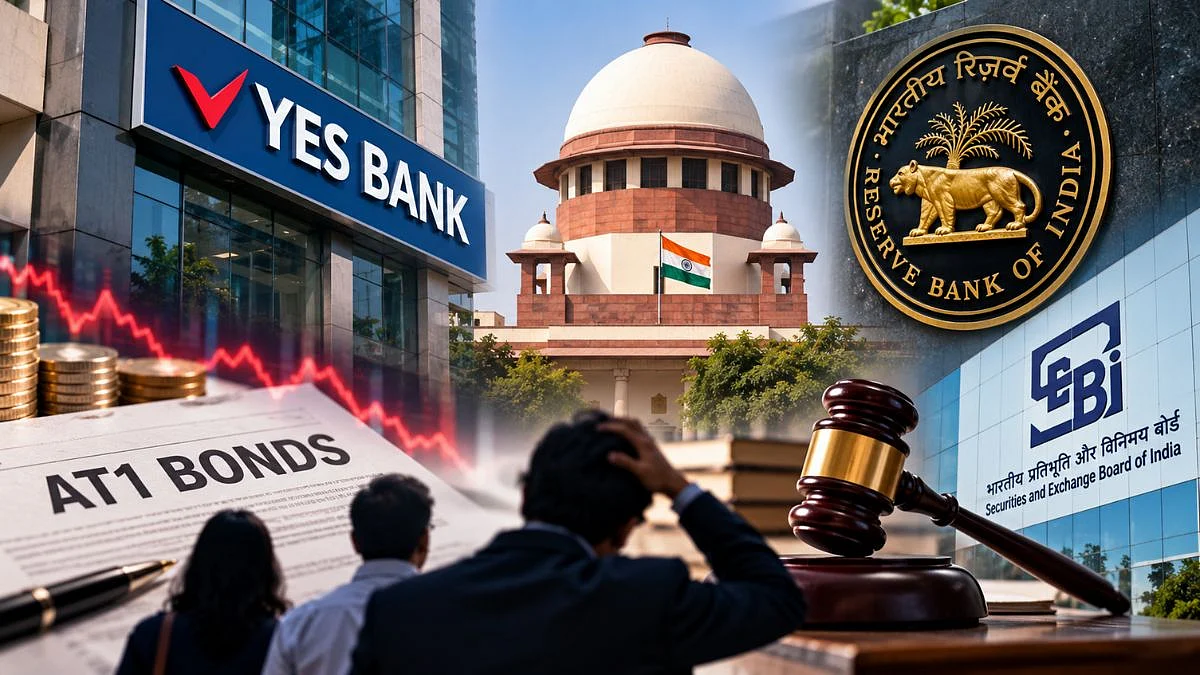
The October 15 Supreme Court judgment upholding the overturning of Yes Bank's Additional Tier 1 (AT1) bond write-off raises crucial questions about regulatory oversight in India's financial system. While the Reserve Bank of India (RBI) may have had legitimate motives in rescuing Yes Bank in March 2020 to safeguard depositors and maintain financial stability, these reasons do not excuse the bank's collapse into insolvency.
The draft reconstruction scheme initially included a provision to nullify the AT1 bonds, but this was later removed, yet the administrator proceeded with the write-off the following day. The court's decision to overturn the Bombay High Court's ruling on the write-off underscores that financial stability cannot be achieved at the expense of regulatory compliance.
A deeper issue emerges from the fact that banks often pay premiums for deposit insurance, yet troubled banks continue to receive rescues through takeovers by other institutions, even when such actions may not pose a systemic risk. This raises concerns about the adequacy of regulation and the quality of oversight, as bailouts are frequently handled by decisions taken at the highest levels, outside the purview of market scrutiny.
The Reserve Bank of India must clarify why the write-off proceeded without the necessary authority and whether losses were allocated between shareholders and AT1 bondholders in line with contractual terms and regulatory rules. The mis-selling of AT1 bonds to individual investors is another area where regulatory failures come to light.
In April 2021, the Securities and Exchange Board of India (SEBI) took action against Yes Bank for deficiencies in the sale of these AT1 bonds, highlighting that the securities were represented as secure, comparable to fixed deposits, when they were in fact high-risk investments. While SEBI's investigation was commendable, the RBI must address how these sophisticated capital instruments made their way into the hands of ordinary investors through the bank's distribution channels and whether the regulator adequately monitored the sales process.
The lack of SEBI's more proactive role in this situation is particularly troubling, given that both the issuing bank and the AT1 bonds fall under its regulatory jurisdiction. As mutual funds held stakes in Yes Bank, exposing their investors to the consequences of the reconstruction, SEBI could have taken a more visible stand to protect these investors' interests.
Yet, it appears that the securities regulator was not proactive enough in this matter. The Supreme Court's ruling clarified the legality of the write-off, but practical issues remain unanswered. The restoration of the ₹8,415 crore principal, the correct treatment of unpaid coupons, and the reinstatement of the bonds' status and associated rights are still unresolved.
These questions affect reported profits, capital levels, and investor decisions. SEBI should conduct a thorough review of disclosures made to stock exchanges, while the RBI should assess the broader implications for financial stability. As the court's judgment settles the legal aspects of the write-off, critical practicalities remain open.
The reinstatement of the principal and the restoration of the bonds' status will have significant capital and accounting implications for Yes Bank, potentially reducing its core equity capital ratio. Rating agencies have estimated that the ratio could drop to around 10%, assuming accumulated coupons must be recognized and paid. The Reserve Bank of India must clarify the impact on regulatory capital.
Moreover, Yes Bank must transparently explain its accounting treatment of these issues, its timeline for reinstating the bonds, and how it will calculate the accrued coupons. Investors cannot be left in a state of uncertainty; the bank must provide clear guidance on how it intends to balance its obligations to restore capital with the need to maintain sufficient capital for future lending.
The accountability of regulators cannot be one-sided. While the RBI must explain the circumstances that led to Yes Bank's collapse, the manner in which the write-off proceeded without authority, and whether the applicable loss allocation rules were adhered to, SEBI must also clarify whether it effectively safeguarded mutual fund investors and whether stronger intervention was warranted.
The Supreme Court's ruling does not render AT1 bonds inherently risk-free; rather, it establishes that investment risks must be governed by law. True regulatory success lies not only in penalizing market participants but also in identifying risks early, acting within its legal authority, protecting investors, and acknowledging its shortcomings.
When securities can be written off through procedures deemed unauthorised by the Supreme Court, it underscores the urgent need for regulators to take a more active and coordinated approach in preventing such occurrences in the future.
Written by urgent.news from Free Press Journal's reporting — not their text. Machine-written — may contain errors; check the original before relying on it.