NASA Conducts RS-25 Engine Test in Support of Future Artemis Missions
NASA tested RS-25 engine No. 10001 on Oct. 21 on the Fred Haise Test Stand at NASA’s Stennis Space Center near Bay St. Louis, Mississippi. Test teams fired the developmental engine for almost eight-and-a-half minutes (500 seconds), the same amount of time RS-25 engines fire during launch of NASA’s SLS (Space Launch System) rocket. During […] The post NASA Conducts RS-25 Engine Test in Support of…
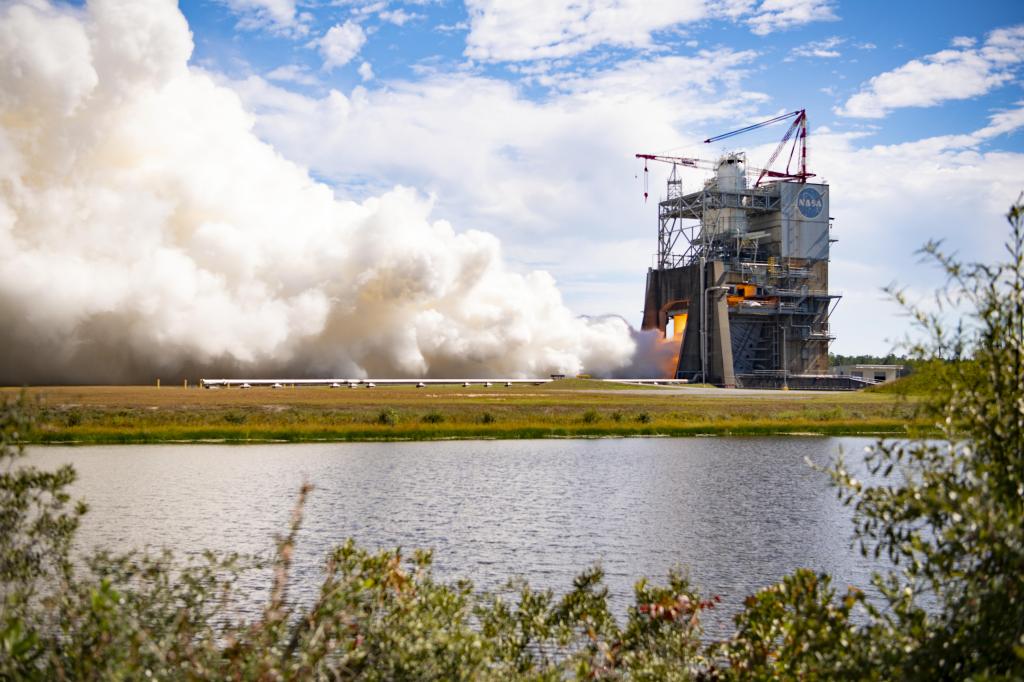
NASA performed a hot fire test of the RS-25 engine, number 10001, at Stennis Space Center in Mississippi on October 21, 2026. This test served as a support for upcoming Artemis missions. The RS-25 engine, known as No. 10001, was activated for approximately eight-and-a-half minutes, mirroring the duration of an actual launch. The engine operated at 111% power, matching the thrust required for NASA's Space Launch System (SLS) rocket and the Orion spacecraft during lift-off.
The primary goals of this test were to validate the flight components of the RS-25 engine for Artemis missions and to validate the new thermal protection system, safeguarding the engine nozzle from the intense heat around the SLS during launch. Although this particular engine will not be utilized in a flight, the data gathered from this test will aid NASA and its contractor L3Harris Technologies in enhancing engine performance and reliability.
Each Artemis mission requires four RS-25 engines, each capable of producing up to 2 million pounds of thrust. Prior to any use, all RS-25 engines undergo rigorous testing and are deemed flightworthy at NASA's Stennis Space Center. The tests are conducted by a team comprising operators from NASA, L3Harris, and Nova Space Solutions.
Written by urgent.news from NASA Science's reporting — not their text. Machine-written — may contain errors; check the original before relying on it.