How Flare Ribbons Reveal Hidden Solar Explosions on the Sun
Solar flaring is complex behaviour triggered by reconnection, when magnetic field lines break and then snap back to the Sun's surface. The flaring is complex behaviour, and its details are difficult to observe. Researchers found a new way to study flaring behaviour.
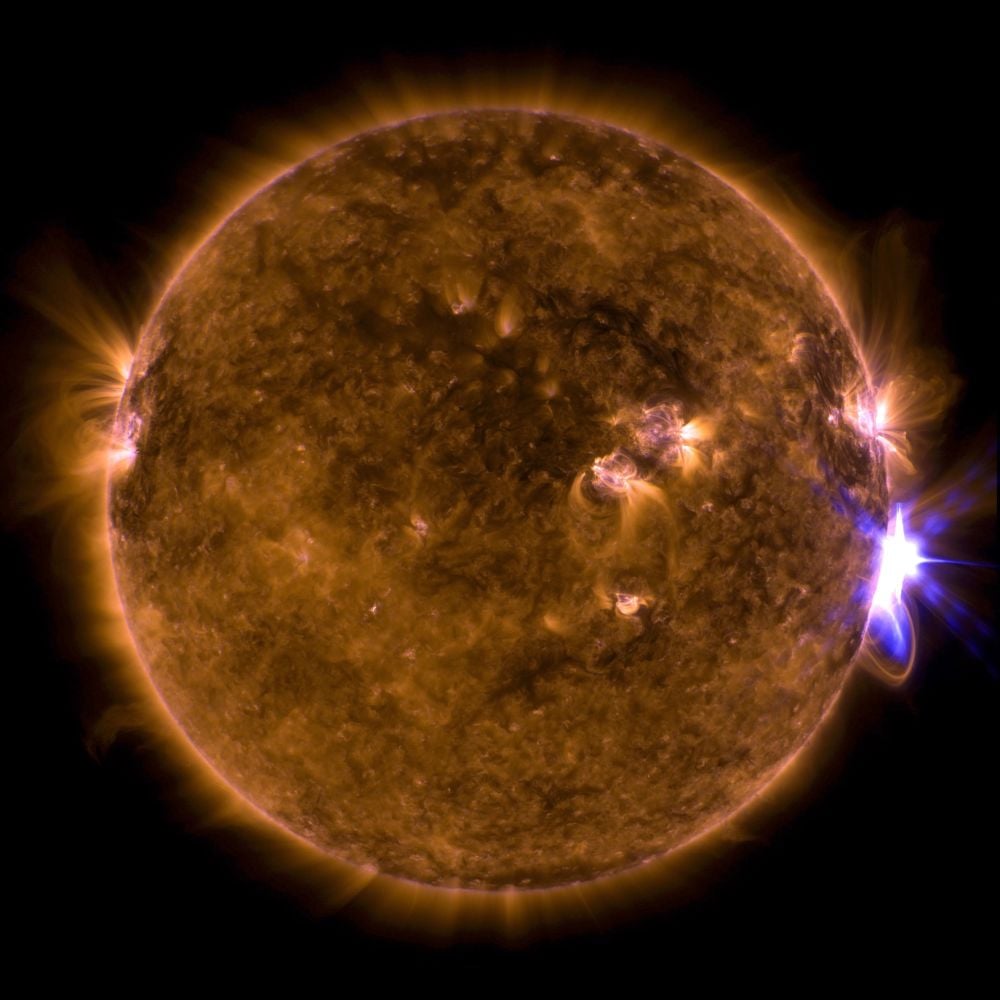
Solar flares are powerful explosions on the Sun, releasing vast amounts of energy. They are classified by their X-ray brightness, ranging from A to X. Solar flares can cause aurorae, disrupt communication systems, and even damage spacecraft electronics. Due to their hidden location in the Sun's corona, observing flares is challenging.
However, researchers have focused on "flare ribbons," which are plasma and high-energy particle structures that form during reconnection events. These ribbons provide clues about the energy conversion region in the Sun's corona. A recent study in The Astrophysical Journal analyzed the evolution of flare ribbon substructure and its relationship to magnetic reconnection dynamics.
The researchers used a novel tool adapted from another field to quantify the irregular shapes of flare ribbons and their substructure. They found that the complexity of the ribbons increased with the reconnection rate, providing experimental evidence supporting the theory. This research marks the first time a physical relationship between the irregular shapes and the energy conversion region has been experimentally confirmed.
Written by urgent.news from Universe Today's reporting — not their text. Machine-written — may contain errors; check the original before relying on it.