First-Ever Pair of Hooded Vultures Arrives at Chester Zoo, and They "Look Like They’ve Just Put a Hood Up"
Learn more about hooded vultures, why they're important to the environment, and why they're so endangered.
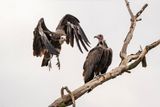
When one imagines lovebirds, hooded vultures likely do not spring to mind. However, a pair of critically endangered vultures has recently arrived at Chester Zoo and is already capturing the hearts of visitors. Bird keeper Heather-Anne Pedley expressed her excitement about the new arrivals, saying, "Nobody prepared me for how much I would fall in love with them, their antics and characters."
Though the vultures are new to the zoo, the pair already shares a strong bond, and zookeepers are hopeful they will soon become parents, marking a first for Chester Zoo. The hooded vultures are part of a Europe-wide conservation breeding program aimed at preserving the species. Named Claudia and Alan after TV personalities Claudia Winkleman and Alan Carr, the vultures are already stealing hearts with their antics and engaging personalities.
Hooded vultures are among the smallest 'Old World' vultures, with a wingspan ranging from 61 to 65 inches and a body length of 24 to 28 inches. They weigh between 3.3 and 5.7 pounds and are monogamous, mating for life. In the wild, they can be found in parts of sub-Saharan Africa, including Senegal, Niger, Chad, South Sudan, Somalia, and Ethiopia.
Their name comes from the cream-colored feathers on their heads and backs, making them look like they are wearing a hood. The rest of their body is covered in chocolate-brown feathers, with white patches on their chests. Their faces are featherless, and they have a distinctive blue ring around their eyes.
These vultures play a crucial role in the environment, consuming carrion and helping prevent the spread of zoonotic diseases. However, hooded vultures are critically endangered, with their numbers declining due to poaching and pesticide exposure. According to a 2024 study, hooded vultures are not the only Old World vulture species at risk, with 16 of the 23 species classified as "Near Threatened" to "Critically Endangered" on the IUCN Red List. The loss of vulture species could have severe consequences for their environment.
Claudia and Alan are now part of the Heart of Africa aviary at Chester Zoo, sharing an enclosure with two white-headed vultures. The pair is expected to contribute to the next generation of this crucial species through the European conservation breeding program.
Written by urgent.news from Discover Magazine's reporting — not their text. Machine-written — may contain errors; check the original before relying on it.