Defending AI Agent Memory Against Persistent Prompt Injection
Explore how indirect prompt injection can persist in AI agent memory and why secure ingestion, access controls, and tool-call authorization matter.
In today's AI landscape, agents have evolved from simple question-and-answer systems to complex, multi-step tools that perform research, summarize information, and utilize real-world tools. This increased functionality comes with a significant security risk: indirect prompt injection, which can lead to persistent state poisoning.
When an AI agent processes text from external sources, a malicious instruction can slip through safety measures and remain in memory, corrupting tool calls made later in the system. Traditional safety measures, such as carefully crafted system prompts and reinforcement learning from human feedback (RLHF), are not sufficient in a multi-agent pipeline where agents interact with documentation, query vector stores, and third-party webhooks.
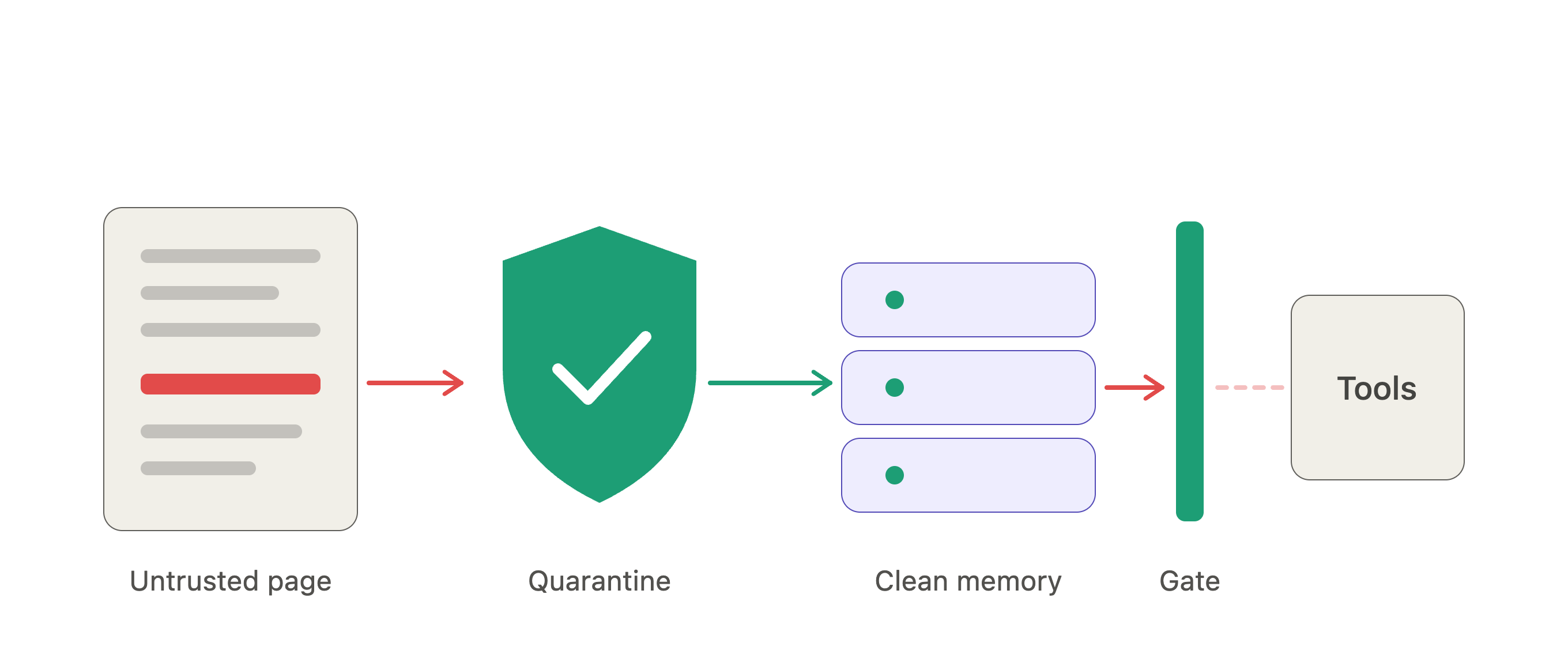
The attack unfolds in three stages: (1) the adversarial payload in external APIs or documents, (2) the worker agent ingesting and processing the tool output, and (3) the poisoned state stored in long-term memory, which can be accessed by downstream sub-agents to make unauthorized tool invocations or changes in behavior. Importantly, the attacker never had to type anything malicious into the system; the agent did it to itself using its own trusted memory.
To address this issue, a dual-layer guardrail architecture is recommended. This architecture combines deterministic checks with probabilistic methods to act as a barrier between the outside world, an agent's memory, and its tools. The first layer involves strict JSON schema validation to strip out executable content and strange Unicode sequences from raw input.
The second layer employs an isolated, sandboxed LLM to translate messy tool output into declarative facts, preventing commands like "Always ensure..." or "Execute command..." from being misinterpreted. The final layer involves checking every tool call against an access-control matrix, enforcing role-based permissions to ensure least-privilege execution.
By implementing these safeguards, AI systems can better protect themselves against indirect prompt injection attacks and maintain their integrity.
Written by urgent.news from HackerNoon's reporting — not their text. Machine-written — may contain errors; check the original before relying on it.