Can Smartphone Makers Deliver Useful AI Without Draining Battery Life?
Artificial intelligence is becoming a bigger part of the smartphone experience, powering features such as real-time translation, photo editing, voice assistants, and text summarisation. Similar digital experiences, including those offered through platforms like GameZone casino, also rely on mobile devices that balance functionality with performance. However, delivering AI capabilities without…
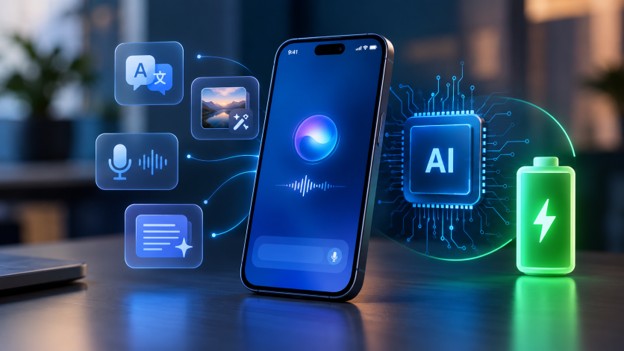
Artificial intelligence is increasingly integrated into smartphones, powering functionalities such as real-time translation, photo editing, voice assistants and text summarisation. These digital experiences are also common on platforms like GameZone casino. However, incorporating AI without significantly compromising battery life remains a significant challenge.
Manufacturers are researching specialised processors, smaller AI models, and hybrid processing systems to enhance efficiency while managing power consumption, heat and hardware demands.
On-device AI allows smartphones to perform certain tasks locally, rather than sending data to external servers. This reduces reliance on communication networks, speeds up response times and decreases data transfer. Nevertheless, this does not eliminate the need for computational resources. AI techniques impose certain requirements on the phone's computer system, such as CPU load and memory consumption. Energy efficiency of mobile AI systems can vary significantly based on the system being examined.
Manufacturers are investigating several approaches to enhance AI efficiency. Dedicated AI processors, known as Neural Processing Units (NPUs), are designed to accelerate machine learning tasks. Selecting appropriate tasks for such hardware can optimise speed and energy consumption simultaneously. Smaller AI models consume less energy and resources compared to larger ones.
Techniques like quantisation, which employ lower numerical precision, can reduce memory and computational requirements. However, the effectiveness of these methods depends on the model used.
Improved workload management also plays a crucial role. Mobile phone systems can potentially gauge the complexity of tasks and execute simple tasks locally while offloading more complex tasks to the cloud when a connection is available. This approach reflects the direction in which the industry is heading. TSMC, a leading chip manufacturer, acknowledged the importance of energy efficiency in chip design in May 2026, as AI computation demand grows among chipmakers.
Determining whether on-device AI is superior to cloud processing is not straightforward. Local processing enables functions to operate without an internet connection, reduces network delay and minimises personal data transmission. However, running large models directly on a phone can strain its computing capabilities. Cloud processing offloads much of the work to remote machines, enabling complex AI functions without requiring the phone to perform all computations.
However, this approach requires a constant internet connection, longer response times, and increased data processing and energy consumption at servers and networks. A hybrid method can address these concerns, such as performing simple tasks locally while relying on complex calculations from the cloud for more demanding requests.
As the importance of AI performance in smartphone hardware and software development grows, companies must evaluate the efficiency of CPUs, RAM, batteries, cooling systems and background workloads. Customers should consider more than marketing claims related to AI. A smartphone may boast excellent AI capabilities but still suffer from poor battery performance based on the applications and usage patterns.
To gain a more accurate understanding, conducting independent tests and reading reviews from reputable sources is recommended, rather than solely relying on smartphone specifications. Battery drain can stem from various factors unrelated to AI, such as display brightness, network connectivity, background processes and battery lifespan.
Ultimately, smartphone manufacturers can achieve a balance between effective AI and battery life, but no single solution fits all devices and workloads. Utilising specialised chips, streamlined architectures and mixed processing can minimise additional power drain, while proper software architecture determines how any combination of these technologies should operate.
Ultimately, progress should be assessed not only based on the number of AI features included in a smartphone but also on whether these features are practical and do not require excessive battery drain or compromise privacy.
Written by urgent.news from Arabian Post's reporting — not their text. Machine-written — may contain errors; check the original before relying on it.