African Elephants Shape the Savanna Ecosystem—and Continue Doing So Long After They've Died, Study Suggests
At first, plants below an elephant carcass die. Soil microbes and plants grow back soon after, but only a few select species. Herbivores later come in to munch on the nutrient-rich greens
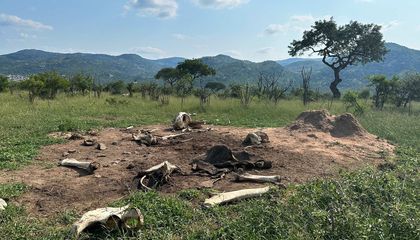
African savanna elephants are often referred to as ecosystem engineers. Throughout their lives, these colossal creatures uproot trees, dig wells, and disperse seeds through their waste. But even after their demise, the effects of these gentle giants on the environment continue, as revealed by a study published in the journal Proceedings of the National Academy of Sciences on October 12.
Researchers discovered that the influence of an elephant lasts for at least eight years, involving a complex chain of events involving microbes, plants, and animals.
Following the death of an elephant named Alexander in Kruger National Park, South Africa in 2009, scientists started to wonder about the impact of a carcass on the soil and food web. This curiosity led to a larger study where soil chemistry, microbiology, biodiversity, and herbivore feeding were investigated near 40 elephant carcasses in the park between 2023 and 2025. The carcasses had died between eight days and nearly eight years before the samples were collected.
Initially, the large animals' bodies killed off all biomass directly beneath them. As scavengers descended to feast on the carcass, they cleared the surrounding area. The remains then leached nutrients into the ground, significantly increasing their nitrogen levels. "At really fresh carcass sites, soil nitrogen concentrations can be up to 3,000 times higher" than areas without a carcass, says lead author Courtney Reed, an ecologist at Princeton University.
The sudden influx of nutrients, however, was not beneficial for plants. The excessive amount was toxic and inhibited their growth. Conversely, microbial activity in the soil increased, although only a few species took advantage of the situation. Once the nutrient concentrations decreased, the plants began to behave similarly to the microbes, with only a few fast-growing species dominating the hyperlocal environment for at least eight years.
These fast-growing plants were particularly nutritious and drew grazing animals, which continued to return to the site and further fertilize the land with their waste. The presence of herbivores like zebras, buffalo, and rhinos kept the cycle going, attracting more animals that in turn fertilized the land.
Interestingly, the savannas might be especially susceptible to a strong, long-lasting ecological cascade. The team hopes to test these ideas in sub-Saharan Africa, and they will continue monitoring the carcass sites in Kruger National Park to observe how the land continues to change. As Philip Barton, an ecologist at Deakin University in Australia, put it to the Washington Post, "There are hidden processes occurring underground all across our landscapes, and they are critical to driving ecosystem structure and function."
Written by urgent.news from Smithsonian's reporting — not their text. Machine-written — may contain errors; check the original before relying on it.