The James Webb telescope is watching one of the earliest supernovas in the universe unfold
Astronomers using the James Webb Space Telescope may have discovered a supernova erupting just 1.1 billion years after the Big Bang.
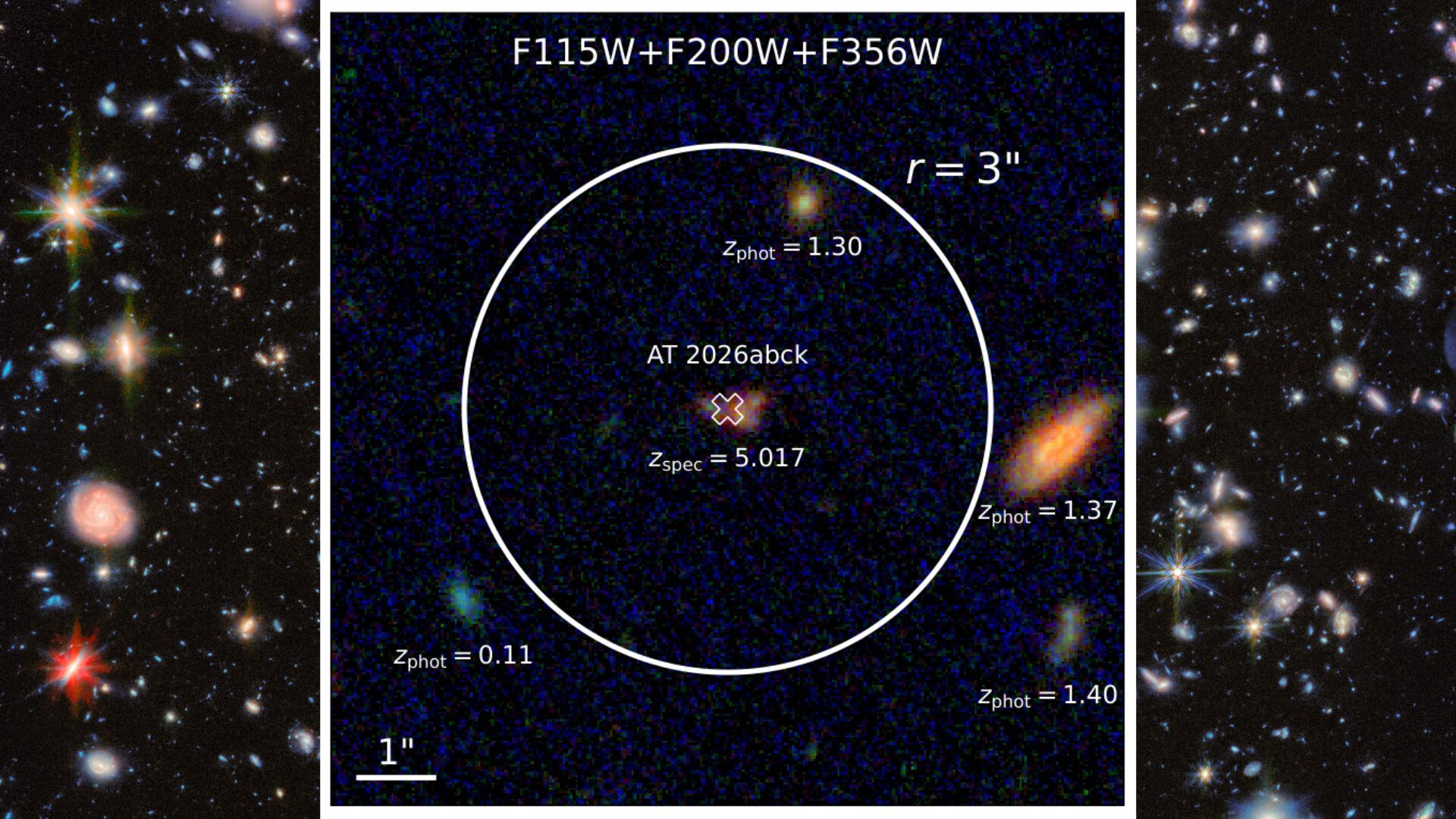
Astronomers using the James Webb Space Telescope (JWST) have discovered what may be one of the most distant supernovas ever observed. The supernova, named AT 2026abck, is believed to have occurred around 1.15 billion years after the Big Bang, when the universe was less than one-tenth of its current age and teeming with massive stars.
The explosion violently released its light 12.5 billion years ago, with the distance to the supernova effectively increasing sixfold due to the universe's expansion. The ancient supernova is incredibly bright, emitting about 8 billion times the brightness of the sun at its peak, comparable to the brightness of the entire Milky Way Galaxy.
Over the course of the explosion, it radiated the same amount of energy that the sun will emit over 2 billion years. The newly discovered supernova shines with a temperature of over 30,000 degrees Fahrenheit (16,000 degrees Celsius), and its ejected material has expanded to a radius of approximately 46 astronomical units, equivalent to the distance between Earth and the sun.
The host galaxy, ID101411, contains about 6.3 billion solar masses and is forming new stars at a rate more than ten times faster than our Milky Way. The researchers were fortunate to observe the supernova as it appeared just four to 10 days after it exploded, which is relatively rare. The discovery was made part of the NEXUS Treasury program, in which JWST periodically scans patches of the sky for ancient explosions.
This supernova was observed without the assistance of gravitational lensing, a phenomenon that magnifies the light from distant objects. Unlike other distant supernovas, this one was not discovered due to the help of a massive foreground galaxy cluster. The unique discovery highlights how the universe's expansion slows down time from our perspective, making the observed explosion appear in slow motion, about six times slower than it actually happened.
The authors of the study believe the supernova may be one of the universe's rarest and most powerful explosions, a superluminous supernova that releases tens or hundreds of times more energy than conventional supernovas. Further observations will help determine the exact nature of this ancient explosion.
Written by urgent.news from Live Science's reporting — not their text. Machine-written — may contain errors; check the original before relying on it.