Pakistan army chief arrives in Tehran as Iran seeks leverage in US talks
Pakistan’s army chief, Field Marshal Asim Munir, has arrived in Tehran with an official delegation to meet senior Iranian officials, amid stalled diplomatic efforts to end the war between Iran and the US. Field Marshal Munir is in the Iranian capital to discuss efforts to resolve the conflict and broader regional developments, the official Irna news agency reported. Islamabad has played a central…
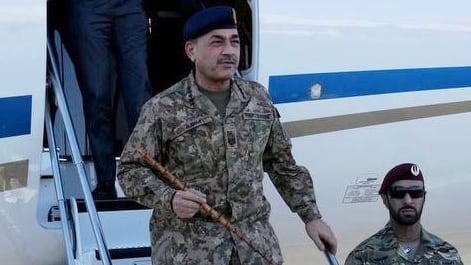
Field Marshal Asim Munir, Pakistan's army chief, has arrived in Tehran alongside an official delegation to engage with senior Iranian officials. The visit comes amid a stalemate in diplomatic efforts to end the conflict between Iran and the United States. The official state news agency, Irna, reported that Munir was there to discuss resolving the war and broader regional issues.
Pakistan has played a crucial role in mediating between the US and Iran, maintaining regular communication with both parties. Meanwhile, Qatar, another mediator, stated that communication between Iran and the US had not ceased, with the goal of reaching a solution as soon as possible. However, Qatar's media director, Ibrahim Al Hashmi, cautioned that threats to cut undersea cables in the Strait of Hormuz, coupled with dangers from sea mines and oil spills, could negatively impact regional nations, including Iran. He urged Tehran to respect freedom of navigation and environmental protections.
The timing of Munir's visit coincides with reports from Iranian officials suggesting that Tehran has been deliberately prolonging negotiations with Washington to undermine US President Donald Trump's political standing before the November midterm elections. One Iranian official stated that Iran was preparing for possible renewed military action against Israel and the US, rather than seeking a deal to end the war.
The clerical establishment, according to the report, is determined not to grant Trump a political victory. Iranian officials also noted that there were slim prospects of a breakthrough before the November 3 election.
Iran has proposed reopening the strategic waterway within seven days in exchange for lifting the US maritime blockade, easing restrictions on Iranian oil exports, releasing frozen assets, and an end to hostilities on all fronts. However, the deadlock persists as Iran's economy faces mounting pressure from sanctions and the blockade. The Strait of Hormuz remains severely disrupted, with shipping severely hindered.
The visit of Field Marshal Munir to Tehran has been linked to rising oil prices, with Iranian hardline news agency Fars suggesting that the trip had only been finalized on Monday as crude prices approached $110 a barrel. Previous mediator visits reportedly helped lower oil prices but yielded minimal progress in negotiations. Iranian Foreign Minister Abbas Araghchi affirmed that Tehran's proposal remained on the table and that exchanges continued through mediators.
Tehran believed US and Israeli attacks could resume, despite President Trump's assurance that Washington would not strike Iran again before November 3. Iran's distrust of Washington has intensified following previous attacks, including strikes in June 2025 and the commencement of the war in February, shortly after a round of talks concluded.
The threat of renewed military action extends to Pickaxe Mountain, a heavily fortified underground facility near Natanz nuclear complex. Iran has warned that any US attack on the site would provoke retaliation. Foreign Ministry spokesman Esmail Baghaei dismissed claims that Washington could strike the site without facing consequences, describing the notion as "nothing more than a claim."
He emphasized that Iran would not remain silent in response to any attack and cautioned that the US would suffer a blow at least equal to any action it took. President Trump has threatened a potential strike on Pickaxe Mountain, where Iran is constructing a heavily fortified underground facility, the precise purpose of which remains uncertain.
Written by urgent.news from The National Business's reporting — not their text. Machine-written — may contain errors; check the original before relying on it.