Investitionen: Regierung wirbt um Investoren: „Deutschland ist zurück“
Erstmals hat die Bundesregierung einen Investorengipfel veranstaltet. Sie kündigt bessere Bedingungen für Investoren an. Denn: „Die Konkurrenz schläft nicht.“
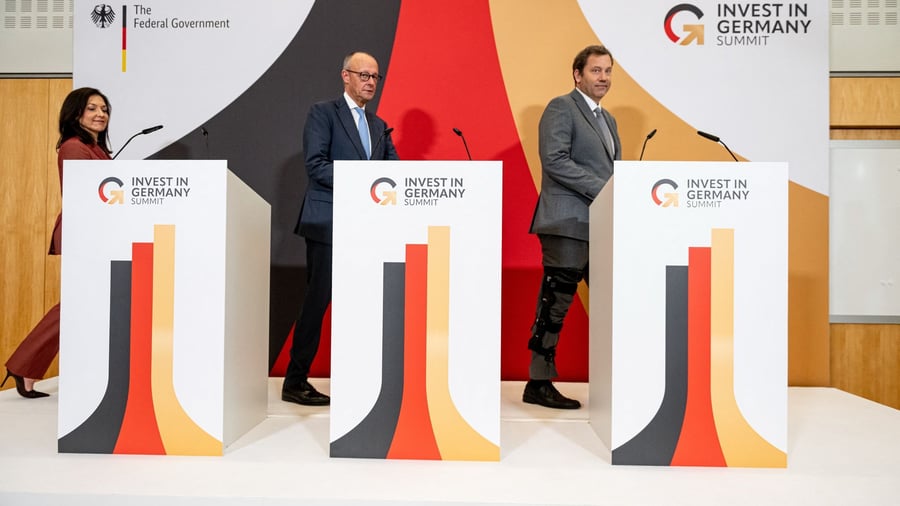
The Federal Government sees Germany on a good path after the first investment summit and years of economic weakness, said Vice Chancellor and Finance Minister Lars Klingbeil (SPD). "It's happening in Germany," he stated. "I would go so far as to say flatly: Germany is back." Chancellor Friedrich Merz (CDU) pledged to give Germany a significant boost.
Merz and Klingbeil told investors to continue the reform course. The Chancellor spoke of a very successful investor conference. The Federal Government would repeat it. The aim was to attract more private investors to Germany. The investment summit had begun the previous evening in a decommissioned power plant in Berlin, with the second day held at a private business school.
According to government data, around 200 international and German executives attended. Merz cited billions in investments in Germany. "In total, up to now, around 230 billion euros in investments have been pledged by the investors we have seen and spoken to." He named Amazon's announcement of investing around 16 billion euros in Germany as an example.
Merz also talked about US chipmaker Nvidia, the German Schwarz-Group, the German energy conglomerate RWE, the US investment firm Blackstone, the US technology conglomerate Microsoft, and the French pharmaceutical company Sanofi. "The list is long and extensive. Germany is a good location for investments." The exact nature of the commitments and whether some of them were made independently of the investment summit remained unclear.
The Federal Ministry of Economics cited a total of 228.6 billion euros as the scope of the largest investment projects in Germany in 2026. Of this, 95.5 billion euros came from foreign companies. Over 70 investment projects with a volume of more than 100 million euros each were identified to calculate this. US e-commerce giant Amazon announced it would invest the money partly in expanding data centers for its AWS cloud provider and modernizing logistics facilities.
"We will be judged by whether this confidence is justified," Merz said, expressing gratitude to investors for their confidence in the country. "We will and we are grateful for this confidence." The Federal Government would further improve conditions for investments in Germany, such as reducing bureaucracy and speeding up approvals.
Merz spoke of one of the most ambitious reform and modernization programs in recent decades. Reforms of the social systems to stabilize social expenditures and flexibility in the labor market were also planned. However, in the red-green coalition, pension reforms are controversial. "We must not burden ourselves further," Klingbeil said.
Germany is back on a growth path. "We must strive further." The coalition must decide on structural reforms. Klingbeil addressed the assembled business leaders with the announcement: "I want your money." The Federal Government expects a significantly higher growth of 1.3 percent this year, driven mainly by state spending on modernization of infrastructure and defense.
Private investments are seen as crucial. "Investments are a key factor for the future of our country, for growth and competitiveness," Merz said. This would bring more jobs, production, and services. DIHK Executive Director for International Trade Volker Treier said that private investment in Germany remained significantly below pre-pandemic levels in the first half of 2026.
"Private investment in Germany is still around 11 percent below pre-COVID levels," he added. "Competition is not sleeping." Economy Minister Katherina Reiche (CDU) said the Federal Government would need to continue promoting Germany as a location in the world. "Because competition is not sleeping." Other countries had also hosted very successful investment summits.
"That means, we are in a competition for capital." Merz sought to dispel clichés about the strengths of the location by using clichés in his morning speech: "Germans are known as hardworking, getting up early and being on standby before sunrise," he said. Morning traffic was at its busiest between 6 and 7 a.m. "When we make vacation arrangements, we are the first at the beach and lay out our towels before breakfast.
And when we make delivery arrangements, we keep them." Germans were reliable, predictable, precise, and good for no surprises, Merz said. "In short, we are exactly what investors most value."
Written by urgent.news from Handelsblatt's reporting — not their text. Machine-written — may contain errors; check the original before relying on it.