Chinese carmakers gear up European production to sidestep tariffs, import quota
Chinese carmakers, facing a European Union import quota targeting their hybrid electric vehicles (EVs), are gearing up for more local production to reinforce their go-global drive. They plan to either splash out billions of yuan to set up their own factories or tap international marques’ idle plants to build their vehicles, looking to sustain a sales boom in one of the world’s major automotive…
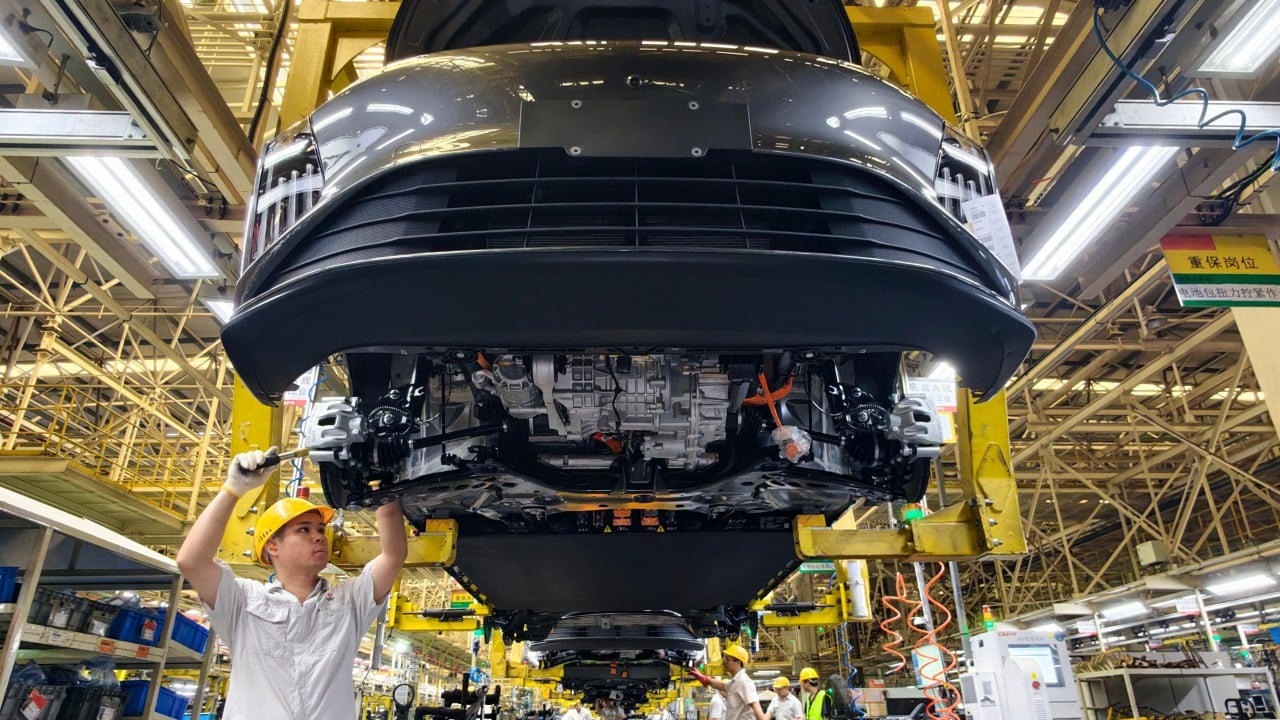
Facing a European Union import quota that targets their hybrid electric vehicles (EVs), Chinese carmakers are preparing for increased local production to continue their global growth strategy. They plan to either invest billions of yuan to build their own factories or utilize idle plants of international brands to manufacture their vehicles, aiming to maintain a sales surge in one of the world's leading automotive markets.
Morgan Stanley analysts highlighted in a recent research note that the global growth is shifting from exporting vehicles to Europe to producing them locally, from relying on price to focus on margins, and moving from a single export channel to a multi-market footprint. This shift would benefit Chinese EV leaders with the scale, financial strength, and European manufacturing plans already in place to adapt quickly.
On October 9, China and the EU agreed on a trade understanding, leading Brussels to impose a quota on imports of Chinese-made hybrid vehicles starting next year. The European Commission is expected to allocate an initial annual quota of 350,000 units, which will rise by 6 percent each year over the next four years. Analysts believe idle plants in Europe may be highly appealing to Chinese carmakers seeking to localize production to avoid import quotas on hybrid cars and high tariffs placed on pure EVs.
Currently, the EU imposes tariffs ranging from 17.8 percent to 45.3 percent on Chinese-made pure electric cars.
Changan Automobile, a state-owned company, announced on October 12 that, through a partnership with a local entity, it plans to produce 180,000 units in the EU by 2028 and increase this capacity to 300,000 cars by 2030. "Our plans for local production in Europe are largely set," said Zhao Fei, president of Changan Automobile. "We are in active discussions with our partner and expect to announce the details before the end of this year."
Byd, the world's largest EV manufacturer, is also considering establishing factories in France and Spain, according to Stella Li, an executive vice-president who spoke to Bloomberg on October 12. The company unveiled earlier this year that its Hungarian plant would commence operations in the fourth quarter of the current year. Chinese carmakers have been hesitant to set up their own factories in Europe due to concerns about costs and regulatory obstacles.
Instead, they are exploring joint-venture factories or engaging local contract manufacturers to produce their vehicles in Europe, where demand for their products is growing rapidly. Chery Automobile, for instance, previously announced a plan to build vehicles with Spanish partner Ebro at a former Nissan facility in Barcelona, with deliveries expected by the end of 2027 or early 2027.
Stellantis, a Dutch multinational, recently strengthened its partnership with Chinese EV manufacturer Leapmotor, aiming to add an EV production line at a Spanish factory that was originally intended for petrol-powered Opel vehicles. Stellantis owns a 21 percent stake in Leapmotor. In July, Geely Auto, China's second-largest carmaker, signed an agreement with Ford Motor to utilize the American company's underutilized capacity in Spain to construct its EVs.
China exported 452,000 hybrid cars to the EU in the first half of 2023, according to the European Automobile Manufacturers' Association. JPMorgan warned in a report that the quota could deal a severe setback to Chinese carmakers, estimating that the country's hybrid vehicle exports to the EU may exceed 800,000 units in 2023. Carlo Diego D'Andrea, vice-president of the European Union Chamber of Commerce in China, expressed concern that the trade restrictions could lead to the closure or restructuring of European car plants and impact China's EV exports.
Written by urgent.news from SCMP Business's reporting — not their text. Machine-written — may contain errors; check the original before relying on it.
This story
This is one outlet's version. Read the fullest account.