Wirtschaftspolitik: Investitionsgipfel in Berlin - Merz rollt roten Teppich aus
Die Bundesregierung zieht alle Register, um mehr Investoren nach Deutschland zu locken. Eine Konferenz soll ein „Willkommens-Signal“ senden. Worum es geht.
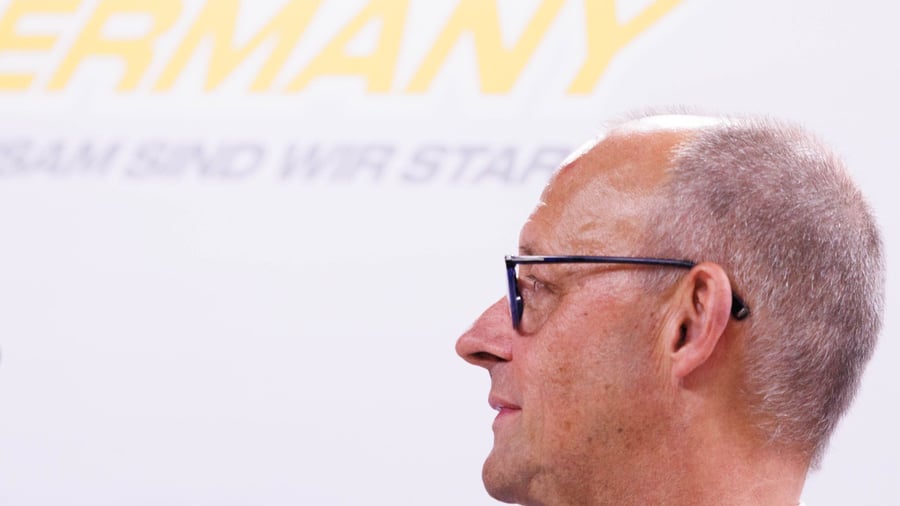
Bundeskanzler Friedrich Merz (CDU) rolled out the red carpet at an Investment Summit in Berlin, focusing on the potential for billions in private investment. The event began with a curated cultural program at a former heating power plant in Berlin-Mitte, which promised an "exclusive" opening with a selected cultural program. Nvidia's CEO, Jensen Huang, was announced as a guest of honor, with the German government planning a collaboration with the company.
The conference, held at the private economic college ESMT at Schlossplatz in the heart of the German capital, gathered around 200 international and German executives.
The German government aims to boost private investments by spending billions on infrastructure and helping companies transition to climate-friendly processes. This is crucial for higher economic growth. However, a sustainable recovery is still needed, warn economists. According to government sources, only public spending won't modernize Germany.
The government wants to mobilize significantly more private capital for investments, including spending on machinery, research and development, modern production sites, or software that increase productivity and thus economic growth. The former Commerzbank CEO, Martin Blessing, has been appointed by Merz as a personal investment ambassador.
Germany presents itself as a top location for investors due to solid finances - Germany is the only G7 country with a Triple-A rating. A stable rule of law, the highest patents among European countries, excellent universities, highly skilled labor, the duty-free EU single market, and a central location in Europe are among the reasons.
A Deutsche Bank survey of international executives found that Germany is an "investment magnet" in Europe. However, there is room for improvement: According to an Allianz Research study, total investments in Germany decreased by 6.4% between 2019 and 2025, while they increased by 6.7% in the rest of the Eurozone and by 20.2% in the USA.
This creates a significant investment gap. Reasons for reluctance to invest in Germany include high energy costs, high tax and duty burdens, and excessive bureaucracy. The government aims to complete "homework" at the summit, including reforms of social systems to stabilize social spending, labor market flexibility, and shorter planning and approval procedures for data centers and support for young companies.
However, the Renten reform in the black-red coalition is controversial. Germany aims to invest in key technologies such as artificial intelligence (AI). The country lags behind internationally in this area. Industrial AI is seen as a great opportunity due to Germany's industrial base and the large amount of data available. Siemens CEO Roland Busch called industrial AI a "century-long opportunity for Germany."
The federal government plans to cooperate with Nvidia to develop industrial AI. The US-chipmaker's products are the central engine of the AI boom. German companies are also expected to participate in a project. Besides industrial AI, the federal government sees promising opportunities for investors in energy, defense, semiconductors, data centers, and transportation infrastructure.
The aim is to increase and accelerate investments in maintenance and the reconstruction of the autobahn company, which can now issue loans. Investors could also be interested in the planned new "pension fund" in pension provision.
Written by urgent.news from Handelsblatt's reporting — not their text. Machine-written — may contain errors; check the original before relying on it.
This story
This is one outlet's version. Read the fullest account.