China's economy grew 4.5% in the third quarter, beating forecasts on export surge
Real estate development investment fell 20.6% and fixed-asset investment fell 7.2% in the first nine months as domestic demand lagged
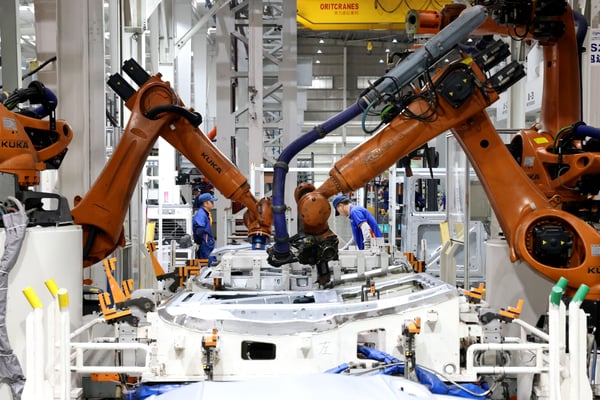
China's economy expanded by 4.5% in the July-September quarter, marking a stronger performance than the 4.3% growth recorded in the previous quarter, according to official figures released on Monday. The upward revision in growth expectations coincides with heightened urgency among China's trading partners to balance their trade deficits with the nation.
For the entire year, Beijing aims for a growth rate of 4.5% to 5%, a target that has been reduced from last year's 5% expansion. While strong exports have fueled China's economic growth, domestic demand has been sluggish, hampered by a prolonged slump in its real estate sector that has eroded household wealth and spurred up savings.
Despite this, China is projected to surpass its 2022 record $1.2 trillion trade surplus, thanks to a 36% rise in exports during September and a $938 billion surplus from January to September. High-tech goods, including semiconductors and electric vehicles, are key drivers of this export surge. As China strives for self-reliance to guard against Western export controls and trade uncertainties, it has amassed substantial manufacturing capacity across sectors like solar power and EVs, which are heavily subsidized by the government.
However, this export-driven growth model has yielded limited job creation and income gains, while the rise of artificial intelligence poses risks of labor displacement. The International Monetary Fund has lowered its forecast for China's economic growth in 2026 to 4.5%, aligning with Beijing's stated goal. The Conference Board's Asia Pacific senior economist, Max Zenglein, cautions that the headline growth figure is becoming an unreliable gauge of the wider economy, as it masks widening disparities across industries, regions, and households.
China's domestic demand has weakened, partially due to a prolonged downturn in its property market, which has squeezed household wealth and driven up savings. Nevertheless, strong exports remain one of the few bright spots for China's economy. The United States' recent tariffs on some Chinese goods have impacted bilateral trade, compelling Beijing to seek new markets, including Southeast Asia, Latin America, and Europe.
High-tech exports, such as semiconductors and automobiles, are among the sectors thriving amid this shift. China's pursuit of self-sufficiency to shield itself from Western trade restrictions and uncertainties has resulted in massive domestic manufacturing capacities across multiple industries, supplemented by government subsidies.
However, the rapid scaling up of output at a time of weakened domestic consumption has led to many goods being exported at competitive prices. While China's export-reliant growth model has been criticized for limited job creation and broad income gains, it has also raised concerns among trading partners about the potential threats to their domestic industries and economies.
The European Union, for instance, runs a trade deficit of over $1.1 billion daily with China. Many EU countries are advocating for more restrictions on Chinese imports, as their trade imbalance with China has widened to more than $1.1 billion per day. EU countries currently have a trade deficit with China of more than $1.1 billion daily.
Written by urgent.news from Fortune's reporting — not their text. Machine-written — may contain errors; check the original before relying on it.
This story
This is one outlet's version. Read the fullest account.
- China’s economy grew 4.5% last quarter, yet its export boom risks being ‘a drag on world growth’ fortune.com
- China's economic growth picks up in third quarter, beating expectations channelnewsasia.com
- China's economic growth picks up in third quarter, beating expectations brecorder.com
- China’s economic growth accelerates to 4.5% in third quarter investing.com
- China’s economy expands 4.5% in third quarter ft.com