Beyond the GenAI hype: Amazon's Rajeev Rastogi bets on agentic AI to boost enterpise operations
Speaking at TechSparks 2026, Rajeev Rastogi, Vice President of Machine Learning at Amazon highlighted the rise of agentic AI in the entire enterprise operating layer, marking a transition from static software to autonomous systems capable of understanding natural language instructions.
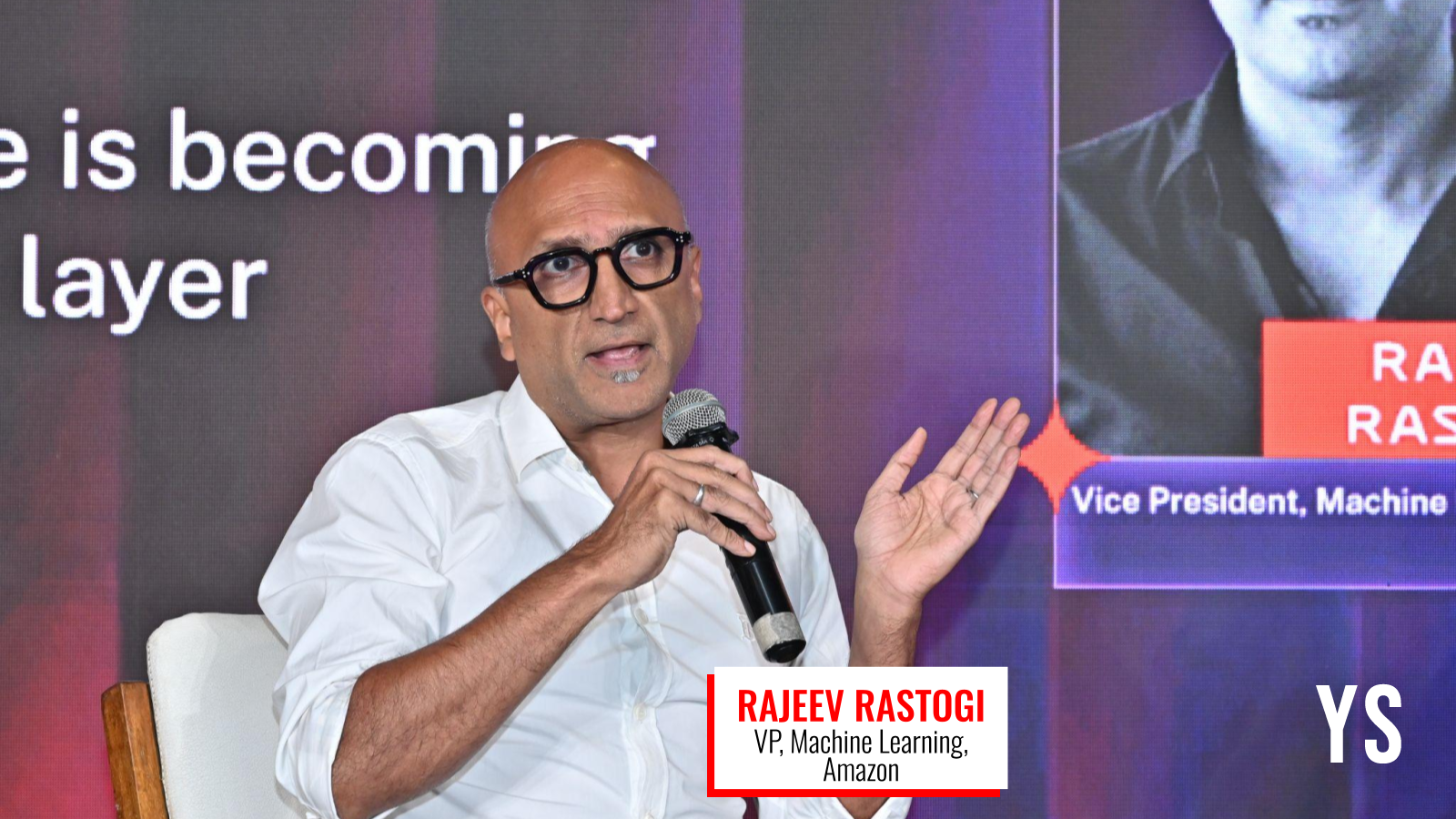
Amazon's Vice President of Machine Learning, Rajeev Rastogi, recently asserted that the company's operating layer is shifting towards agentic AI systems. This represents a departure from traditional static software towards autonomous systems that can comprehend and act upon natural language instructions. Unlike software that operates according to fixed scripts, agentic systems can dynamically formulate plans to solve problems and utilize appropriate tools as needed.
These autonomous agents can evaluate queries, devise a sequence of actions, and call specialized digital tools to carry out complex tasks. In Amazon's ecosystem, this concept is already demonstrated through Rufus, a conversational shopping assistant that parses customer requests, applies price filters, queries search engines, and assists users in product comparisons and checkout.
Similarly, autonomous seller assistants streamline product listing creation, inventory monitoring, and navigate small businesses through international export compliance procedures.
Despite the widespread excitement around generative artificial intelligence (Gen AI), Rastogi cautioned that it is not a panacea for every computing challenge. While Gen AI models excel at complex reasoning, text summarisation, review analysis, and creative tasks such as editing product images, they struggle with high-volume, low-latency applications.
For tasks like ecommerce product search dealing with hundreds of billions of items, traditional machine learning methods, utilizing faster algorithms and classical models, are generally more efficient and cost-effective.
To achieve cost savings, Rastogi suggested that businesses can fine-tune open-source models on specific proprietary data. Fine-tuning involves training a smaller, publicly available model on specialized tasks, resulting in accuracy comparable to larger, closed models at a fraction of the cost. By leveraging these fine-tuned models, enterprises can avoid the prohibitive expenses and computational overhead associated with the most powerful frontier models.
For technology entrepreneurs and enterprise architects, Rastogi emphasized that the most promising opportunities lie in vertical workflow automation rather than attempting to build foundational models from scratch. Developing new frontier models demands unsustainable financial resources and computational infrastructure. Instead, he advocated for building upon existing frontier models using agentic AI to automate workflows in specific domains, such as law, finance, healthcare, agriculture, and human resources.
A particularly valuable area includes automating standard operating procedures, which are typically unstructured natural language documents that guide human workers through complex operational tasks.
Rastogi pointed out that the current generation of frontier models is computationally expensive and environmentally unsustainable. They operate as statistical next-token prediction engines, lacking genuine understanding of physical laws, spatial geometry, or cause and effect. To overcome these limitations, the future of AI will likely involve networks of smaller, domain-specific models guided by central routing orchestrators.
Rather than storing extensive world knowledge within massive model parameters, future AI architectures will separate reasoning capabilities from data storage, relying on external high-speed search engines for information retrieval. The ultimate goal is to develop genuine world models that possess an internal understanding of physical spaces and environmental behavior, creating a practical, cost-effective framework for enterprise automation.
Written by urgent.news from YourStory's reporting — not their text. Machine-written — may contain errors; check the original before relying on it.