Alberta heads to polls to decide whether to hold vote on separation from Canada
Polling suggests most Albertans favour remaining part of the country, although the debate alone has proven divisive.
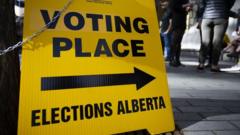
Residents of Alberta, Canada are voting in a referendum on whether the province should pursue a process that could potentially lead to independence. While the outcome of the motion appears unlikely to succeed, the vote's mere existence indicates that economic and political grievances are gaining traction in the region known for its oil reserves.
Separatist leaders anticipate that a comparatively strong showing for their cause could potentially compel Prime Minister Mark Carney's government in Ottawa to pay greater attention to their demands. Voting commenced at 9 a.m. local time in the provincial capital, Edmonton, and is set to conclude at 8 p.m. on Tuesday. Results will be released as they are received.
According to opinion polls, the outcome of the referendum is likely to be in favor of independence, with up to one-third of voters potentially supporting the proposal. This is the first referendum in a province outside of majority French-speaking Quebec, which has a more established separatist movement rooted in language and cultural distinctions.
Alberta, the province in question, is almost twice the size of Germany in terms of land area but is significantly less densely populated, with approximately 5 million residents. Around half of them reside in its two largest cities, Edmonton and Calgary. The provincial government of Alberta is headed by Danielle Smith of the United Conservative Party, while Mark Carney, representing the Liberal Party, leads the national government.
Smith, herself, does not advocate for independence and has encouraged voters to vote against the motion. However, she has authorized the vote, possibly aiming to appease an increasingly vocal faction within her party. Proponents of independence criticize the government for allegedly suffocating Alberta's oil industry through stringent environmental regulations, and also argue that they contribute disproportionately to the national public purse.
Cory Morgan, the founder of a pro-separation organization called Pathway to Independence, contends that the government's actions create an imbalanced system that benefits the central population and government at the expense of the more remote, resource-rich provinces like Alberta. Canadian Prime Minister Mark Carney, who hails from Alberta, has spent the past week campaigning for the 'stay' campaign, emphasizing national pride and urging supporters to vote in a manner that yields a decisive result, even if the race may not be close.
Carney often argues that the separatist cause may overlook issues more significant than financial and drilling permissions. While polls in French-speaking Quebec suggest that enthusiasm for independence is typically a minority sentiment and lower than usual during Carney's tenure, the issue remains a recurring topic in the political discourse.
Carney's efforts to preserve national unity amid pressure from Canada's closest neighbor and largest trading partner, the United States, are also being tested. US President Donald Trump, in his characteristic combative style, has been engaged in contentious trade negotiations with Canada that have threatened to collapse in recent months.
Trump has even gone so far as to propose making Canada the '51st state' of the US and attempting to rename bodies of water, such as Lake Ontario.
Written by urgent.news from DW English (Top Stories)'s reporting — not their text. Machine-written — may contain errors; check the original before relying on it.
This story
This is one outlet's version. Read the fullest account.