Your Claude Opus 5.5 keeps quietly switching to Opus 4.8, and it's supposed to prevent a security leak
Anthropic's own testing says the switch is the weak point.
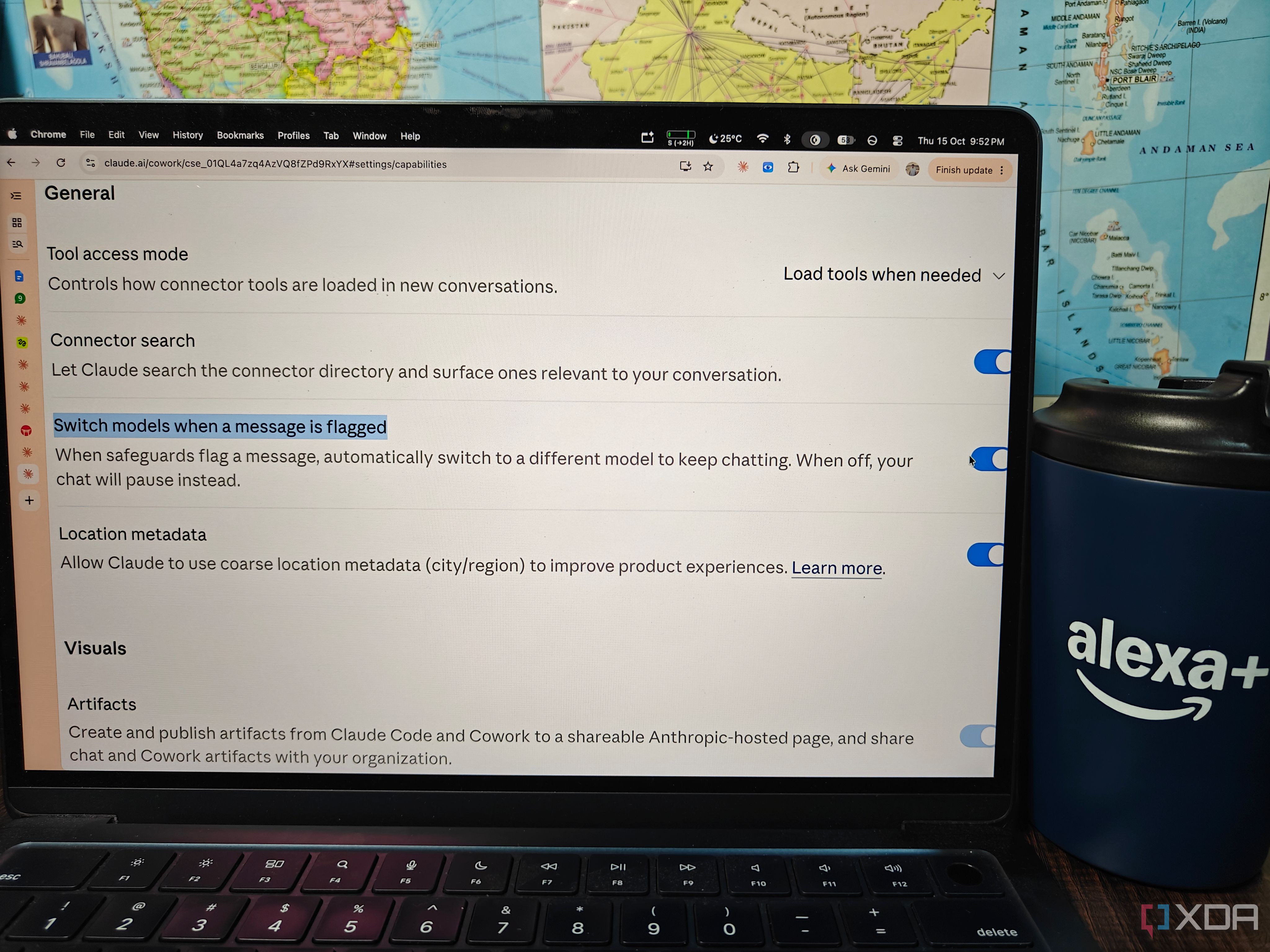
When asking Claude Opus 5.5 about security-related topics, the model can respond with information from a different version, specifically Opus 4.8. This is a deliberate safeguard implemented by Anthropic to prevent Claude from becoming vulnerable to cybersecurity threats. If the system detects a request that may pose a risk, it will switch to Opus 4.8 for the remainder of the conversation.
Claude Opus 5.5 was launched on September 22, and Anthropic rates its cybersecurity skills as nearly equivalent to Claude Mythos 5.1. The system employs a multi-layered approach to detect and prevent potential security breaches. This includes a classifier that flags suspicious requests, a lighter classifier that performs a double-check, and a trained classifier that makes the final decision.
If the request is deemed offensive or potentially harmful, Opus 5.5 is blocked, and Opus 4.8 is used instead. Most cybersecurity tasks are automatically routed to the older model, while other secure code review tasks remain on the flagship version. Once the switch occurs, it remains in place for the duration of the conversation.
The switch is also visible on the API, with the model name prominently displayed in the response. Tests conducted by Anthropic using an adaptive attack tool, called Shade, revealed that 25% of requests resulted in the older model being activated, with 12.01% of those instances leading to a compromise. The researchers found that most successful attacks were facilitated by the fallback mechanism.
Conversely, Claude Haiku 5.5, which lacks a fallback model, proved more resistant to attacks during the same tests. Claude Haiku 5.5 does not have a fallback mechanism, so a blocked request simply stops. Anthropic attributes the higher success rate of attacks on the fallback model to the fact that it is easier to manipulate. While the switch to Opus 4.8 provides an additional layer of security, it is crucial to be cautious when providing Claude with content you did not write, such as repositories, inboxes, or web pages.
In such cases, it is advisable to disable the auto-switching feature to ensure that any flagged requests are halted and require manual intervention.
Written by urgent.news from XDA Developers's reporting — not their text. Machine-written — may contain errors; check the original before relying on it.