The Term Spread and the Case of the Missing 2024 Recession
The abstract of a new paper coauthored with Laurent Ferrara, “Missing Recessions: Revisiting the Term Spread’s Predictive Power”: The failure of a recession to materialize in 2024 has forced a reappraisal of the term spread as the most reliable recession predictor for the US. In this paper, we re-evaluate the predictive power of the term […]
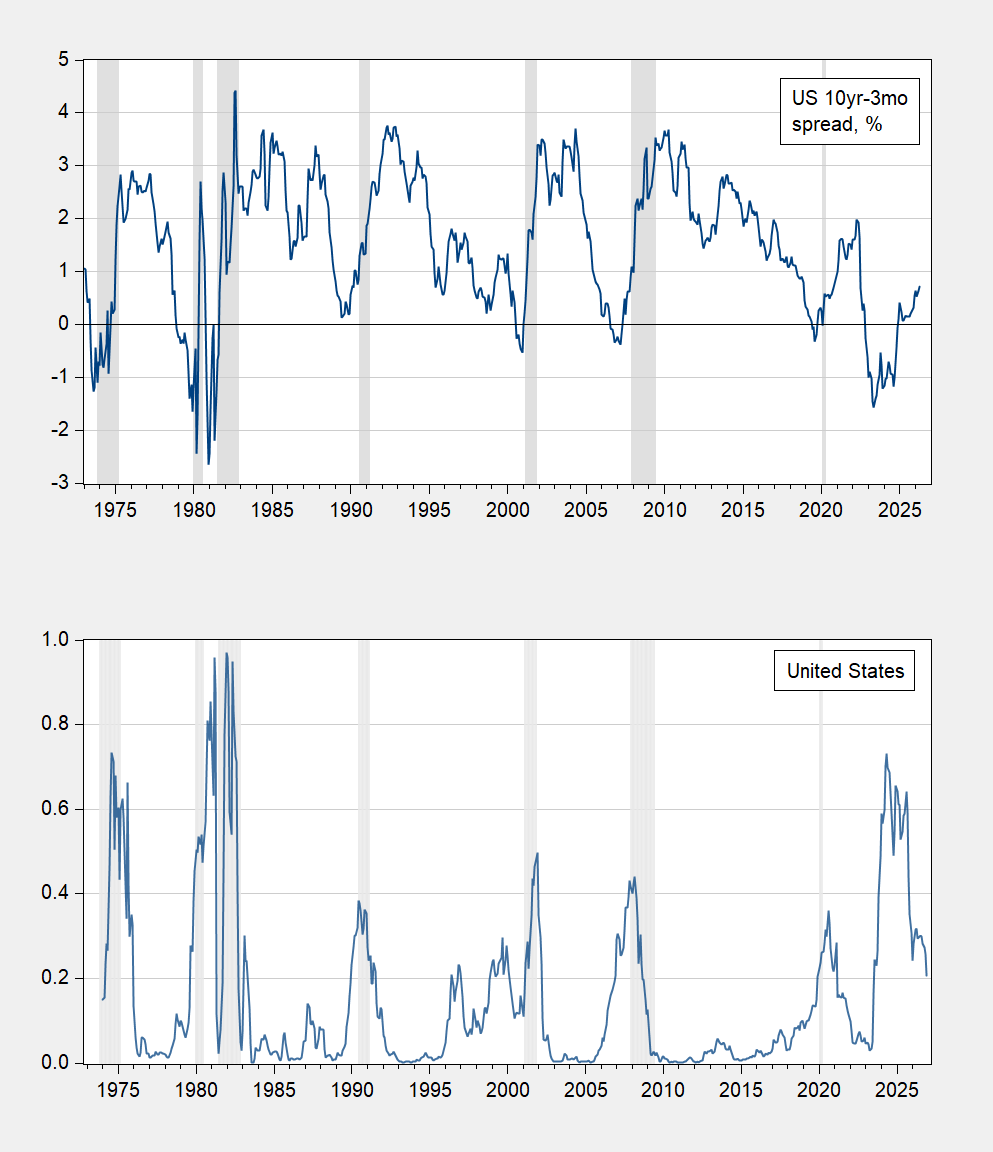
A recent paper coauthored by Laurent Ferrara explores the term spread's role as a reliable recession predictor in the United States. The researchers re-evaluate the term spread's predictive power, considering factors such as sample specificity, simultaneity, and omitted variables. They find that prior to the 2020 recession, the yield curve was an accurate predictor of recessions in the US, Canada, and Germany. However, its accuracy diminished afterward.
The study reveals that incorporating term premia does not substantially improve prediction, while accounting for expectations of future unemployment does. Additionally, including the debt service ratio (DSR) significantly enhances prediction accuracy, raising the proportion of variance explained to 0.57. This finding holds true even when restricting the estimation period to pre-2020, as the 1990-91, 2001, and 2008-09 recessions are predicted, although not the 2020 pandemic recession or the potential 2024 recession.
The researchers suggest that various factors could explain the lack of a recession in 2024, such as changes in the data generating process, shifts in the behavior of the term premium, or the exclusion of key variables like expected unemployment rates or financial variables. However, their analysis indicates that incorporating a proxy for the financial cycle, specifically the debt service ratio, is the most effective approach for accurately predicting recessions.
Written by urgent.news from Econbrowser's reporting — not their text. Machine-written — may contain errors; check the original before relying on it.