India’s Zorawar light tank faces protection and performance trade-off
India's Zorawar light tank program is facing a critical design challenge in upgrading protection without sacrificing mobility. The Indian Army requires stronger armour to resist more powerful ammunition and threats. Development is ongoing by the Defence Research and Development Organisation and Larsen & Toubro, with an expected service entry around 2028-2029. A phased approach might help balance…
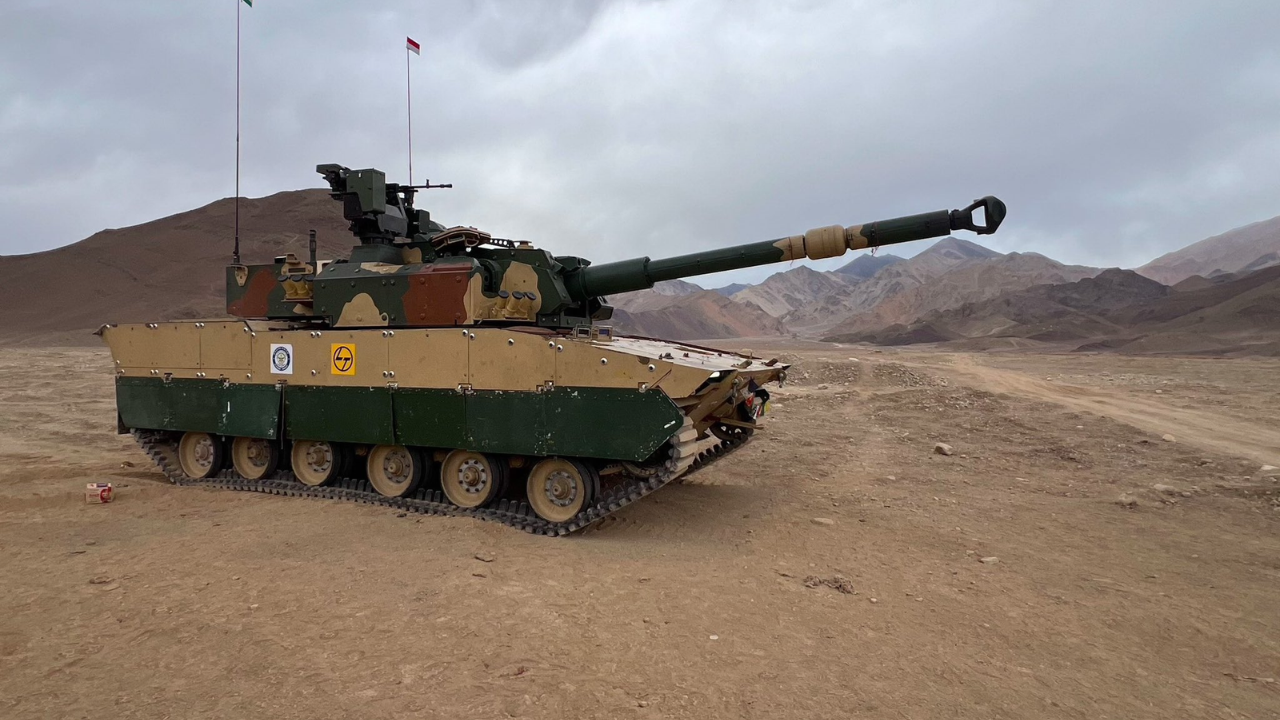
India's Zorawar light tank program faces a critical design dilemma: increasing armor protection without sacrificing the mobility required for mountainous terrain operations along the Line of Actual Control (LAC) with China. This change could add weight, necessitate a more potent engine, and delay the tank's deployment, likely to 2028-2029 according to recent reports.
Developed by the Defence Research and Development Organisation (DRDO) and Larsen & Toubro (L&T), the Zorawar was created following the 2020 India-China border clash in eastern Ladakh. The need for a specialized armored vehicle for mountainous terrain was underscored by China's use of Type 15 light tanks. The Zorawar is designed to be around 25 tonnes, enabling it to balance mobility and firepower while being transportable by aircraft like the C-17 Globemaster III.
It is powered by a Cummins diesel engine producing approximately 760 horsepower and features a 105mm Belgian-designed Cockerill 3105 turret gun. The Indian Army's call for enhanced protection would require the tank to withstand more potent ammunition. Currently, the tank offers STANAG 4569 Level 4 frontal protection, but the proposed demands include Level 6 protection against 30mm armor-piercing rounds, along with stronger side and rear defenses.
Meeting these demands without significantly decreasing the tank's power-to-weight ratio, acceleration, and hill-climbing capability is a significant challenge. Modular armor, such as bolt-on ceramic protection, is being considered, but increasing armor and installing an active protection system could add weight. If the tank's weight rises to 30-32 tonnes, its current engine might not deliver the same performance, requiring a more powerful engine and additional testing.
China's Type 15 light tank serves as a reference point. It is heavier, ranging from 33 to 36 tonnes depending on the configuration, and employs a 1,000-horsepower engine, a 105mm gun, and modular protection. While China's design demonstrates that a heavier platform can function in high-altitude terrain, the Zorawar's requirements and logistical constraints differ.
The Indian Army plans to acquire 354 light tanks, with the first 59 being developed by DRDO and L&T, while Tata Advanced Systems won the remaining 295, with Mahindra Defence Systems also participating in the competition. A phased approach will allow the initial batch to advance while subsequent vehicles incorporate improved protection, determining whether Zorawar can enhance survivability without losing the mobility that defines its role.
Written by urgent.news from Times of India's reporting — not their text. Machine-written — may contain errors; check the original before relying on it.