Japan is launching a mission to Mars’s largest moon Phobos
The Martian Moons eXploration spacecraft, set to launch on 20 October, will bring back samples that should solve a moon mystery that has been vexing scientists for more than a century
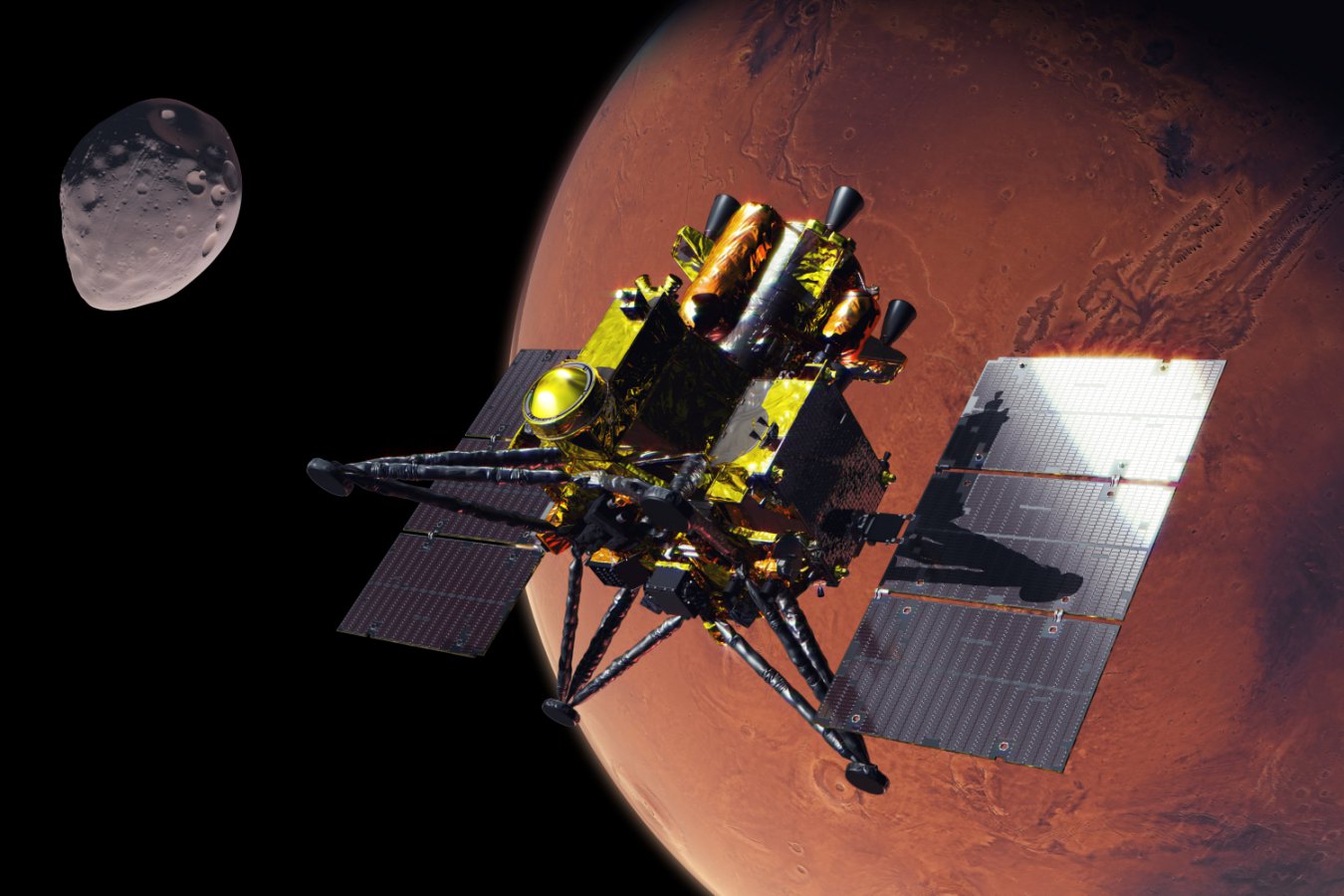
Japan is set to embark on a mission to Mars's largest moon, Phobos, in a bid to unravel the mystery of how the Martian moons, Phobos and Deimos, formed. The Martian Moons eXploration (MMX) spacecraft, scheduled to launch on October 20, will head towards Phobos, the larger of the two moons, with the objective of returning a sample that could provide answers to this long-standing question.
The launch will originate from Japan's Tanegashima Space Center. Upon reaching Mars in August 2027, the spacecraft will maintain an orbit around Mars, closely following Phobos to construct a detailed map of its surface. While mapping Phobos, the spacecraft will also observe Deimos.
Once the map of Phobos is sufficiently detailed, the spacecraft's controllers at the Japan Aerospace Exploration Agency (JAXA) will identify a landing site for MMX. During one or two brief landings, the spacecraft will accomplish two objectives: drop off a small rover named IDEFIX and retrieve samples. The rover is the first to be sent to a small celestial body, and it serves to validate whether a wheeled rover can operate on a body with such minimal gravity.
Beyond scientific observations, the mission's key aspect lies in the samples that MMX will collect. Two types of sampling devices are onboard: one that releases a burst of gas onto the surface, collecting the ejected dust and pebbles in a container, and another that creates a hollow cylinder in the ground to extract a sample a few centimeters deep.
Post-collection, the samples will be stored inside the spacecraft before it returns to Earth, with an anticipated arrival in 2031. Upon landing, scientists will analyze the samples to conclusively determine the origins of Phobos and Deimos. For over a century, scientists have been divided on whether the moons are captured asteroids or formed from a Mars impact, similar to Earth's moon.
Their shapes and surfaces closely resemble asteroids, yet their near-circular orbits around Mars's equator favor the impact theory. Examining the samples will confirm the hypothesis and shed light on the composition of these enigmatic moons. Additionally, the findings will contribute to understanding the early solar system when Phobos and Deimos likely formed.
"Discovering the answer will illuminate that earlier era, which could have contributed significant amounts of water and organic compounds to Earth and the other inner planets," stated Tom Statler, a collaborator from NASA's team working on the MMX mission. The samples from Phobos could even carry traces of dust and debris from Mars itself.
Impacts on Mars might have ejected material into space, which could have settled on Phobos and Deimos' surfaces, preserved there for billions of years. In summary, these samples would not only detail the history of Phobos and Deimos but also offer insights into the history of Mars.
Written by urgent.news from New Scientist's reporting — not their text. Machine-written — may contain errors; check the original before relying on it.
This story
This is one outlet's version. Read the fullest account.