IWF: Bundesbank-Chef hält Warnungen vor neuer Euro-Krise für übertrieben
Auf dem IWF-Treffen in Thailand beraten die Finanzminister über die stark steigenden Zinsen für neue Schulden. Bundesbank-Präsident Nagel warnt vor übertriebener Aufregung.
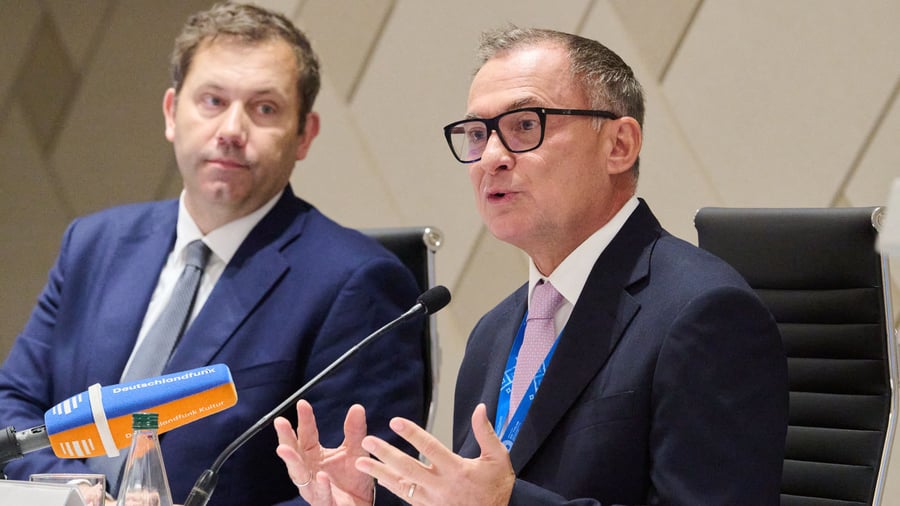
Bundesbank-president Joachim Nagel has dismissed warnings of a new Euro crisis as exaggerated. Speaking at the International Monetary Fund's (IMF) annual meeting, Nagel said he did not see any danger of the euro-area sliding into a major financial crisis. Economists like Ifo-President Clemens Fuest had previously warned of a return of the Euro crisis.
Recently, interest rates on new debt have risen sharply, breaching critical market levels. US Treasury bonds with 10-year maturity reached a high of 5.33 percent, the highest since nearly 25 years. France and Italy must serve their bond investors with 4.9 and 4.7 percent, respectively. Financial actors warn that five percent could be the threshold at which euro-states like France could fall into trouble.
Nagel sees these concerns as overblown. He pointed out the robust growth numbers and the possibility that AI could bring a productivity jump. He also referred to the unstable situation on financial markets, which could lead to rapid changes in either direction. The question of financial stability was a central topic of the discussions at the IMF meeting in Thailand.
Thailands Finance Minister Ekniti Nitithanprapas, who hosted the meeting, cited rising interest rates as part of an economic storm currently affecting his country. Philippine Central Bank Governor Eli Remolona warned the region to prepare against a repeat of the 1997 Asian crisis. IWF Chief Kristalina Georgieva dubbed the US and European countries as the "worst culprits" in terms of debt.
The rising yields there were affecting poorer countries that were forced into saving by financial markets. France is a cause for particular concern in Europe, with a public debt of over 3.5 trillion euros, almost 120 percent of its gross domestic product. The French government now pays 1.5 percentage points more in interest than Germany.
The difference between the two countries' interest rates is about the level of the 2011 Euro crisis. However, there is little evidence of large-scale austerity in France. German Finance Minister Lars Klingbeil, speaking in Bangkok, expressed deep trust in his French counterpart Robert Lescure, saying he saw Lescure tackling the challenges.
Klingbeil repeatedly pointed out the importance of debt reduction and structural reforms during the Bangkok rounds. However, Germany itself has been increasing debt since the coalition government introduced a fiscal policy paradigm shift in the previous year. Annual debt issuance has been in the order of 200 billion euros, particularly due to investment programs for infrastructure and defense.
This is causing concern for the entire Union. In late summer, there was also a debate on whether Germany could lose its top credit rating due to high debt levels and weak growth. Nagel urged the coalition to pursue reforms. He said Germany could justify its high debt levels by investing in infrastructure and its own security. He had no doubt that Germany would remain the "stability anchor in Europe," as evidenced by the stability of financial markets, with investors fleeing to German government bonds due to their perceived safety.
This pushes down the interest rate Germany pays on new debt compared to other countries. However, Nagel warned that the German government must implement the implemented reforms. "The foundation for our prosperity has cracks in certain places, and those cracks must be sealed," he said. The implementation of the reform plans could also lead to growth exceeding expectations.
The Bundesbank President expressed support for the German government against criticism, stating he would not share this assessment. Hope for stronger growth is seen in the first effects of the investment package taking effect this year and continuing next year. The first growth projections this year are 1.1 percent for 2027 and 0.8 percent for 2028.
Finance Minister Klingbeil had planned to embark on his longest overseas trip this week, flying to India to strengthen the partnership with the emerging market. However, after his co-party treasurer Bärbel Bas (SPD) unexpectedly resigned on Monday, Klingbeil decided to travel at least to the IMF meeting. He emphasized the importance of Germany's presence at international meetings, stating that bonds are dissolving and new partnerships must be established to strengthen the mid-cap countries. US Finance Minister Scott Bessent also chose not to attend.
Written by urgent.news from Handelsblatt's reporting — not their text. Machine-written — may contain errors; check the original before relying on it.