It's time to reassess the size of our solar system, scientists say
Two leading space scientists say there is a need to redefine the edge of the solar system based on the Milky Way's gravity, including its dark matter.
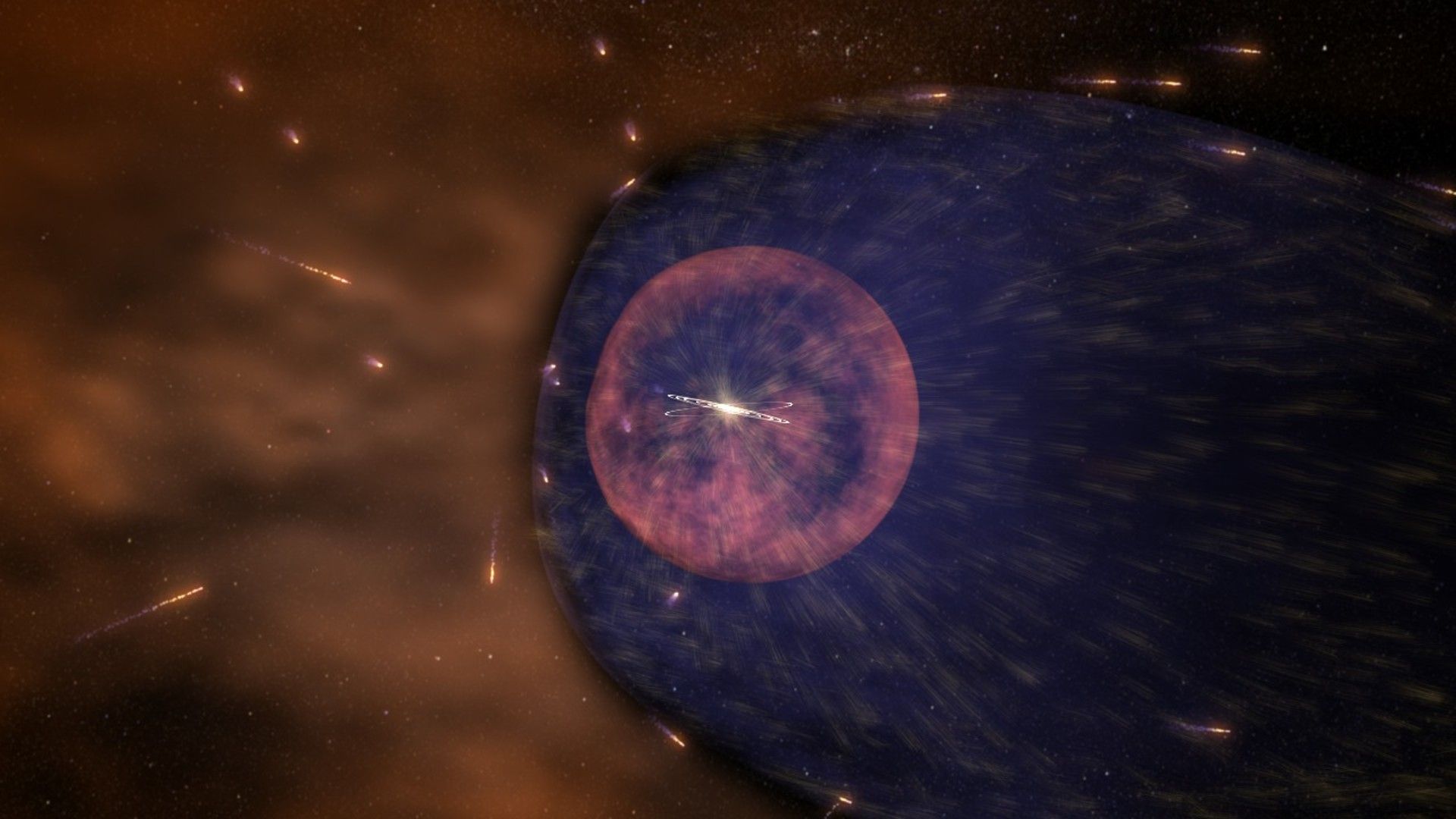
Two prominent space scientists, Jim Green and Ed Belbruno, argue that we must reevaluate the boundaries of our solar system. They propose a new theory suggesting that the outer edge of the solar system extends about 3.8 light-years from the sun, or roughly 241,000 astronomical units, placing it near the distance separating neighboring stars.
According to Green and Belbruno, the solar system's gravitational frontier isn't defined by a clear-cut boundary but by a complex interplay of forces, energies, and trajectories. They present their argument in the August 2026 issue of ROOM - the Space Journal of Asgardia.
The theory also posits that gravitational stable points called Solar Lagrange points L1 and L2 could act as portals that might funnel interstellar objects like comet 3I/ATLAS into our solar system. Capturing such objects could enable scientists to study them further. Green suggests that identifying the solar-galactic center location of L1 and L2 could help discover slow-moving objects that might enter the solar system, potentially even a rogue planet.
Green and Belbruno are considering using the New Horizons spacecraft, which explored Pluto in 2015 and now operates in the outer heliosphere, to observe these areas. They believe that even dust accumulated in this region could help verify their calculations, including the extent of dark matter in our galaxy.
Belbruno, who authored the book Fly Me to the Moon: An Insider's Guide to the New Science of Space Travel, explains that his work on permanent capture into the solar system and weak stability boundaries, published in 2024, forms a significant part of this new theory. He further elaborates that this approach represents a novel application of weak stability boundary theory, originally used in 1987 to find new routes to Earth's moon, to study ballistic capture for spacecraft and estimate the size of our solar system.
The discovery of interstellar objects, such as comet 3I/ATLAS, passing through our solar system on hyperbolic trajectories, has opened up new avenues for understanding the material and processes shaping planetary systems across the galaxy, according to Green and Belbruno. They also touch upon the potential for advanced extraterrestrial civilizations to master gravity, possibly using Lagrange points as portals to observe life within stellar systems with minimal energy expenditure.
Written by urgent.news from Space.com's reporting — not their text. Machine-written — may contain errors; check the original before relying on it.