Is America heading towards a second revolution? A timely and provocative book by Lee Boon Chye — Phar Kim Beng
OCT 16 — The United States has long portrayed itself as the world’s most enduring constitutional democr...
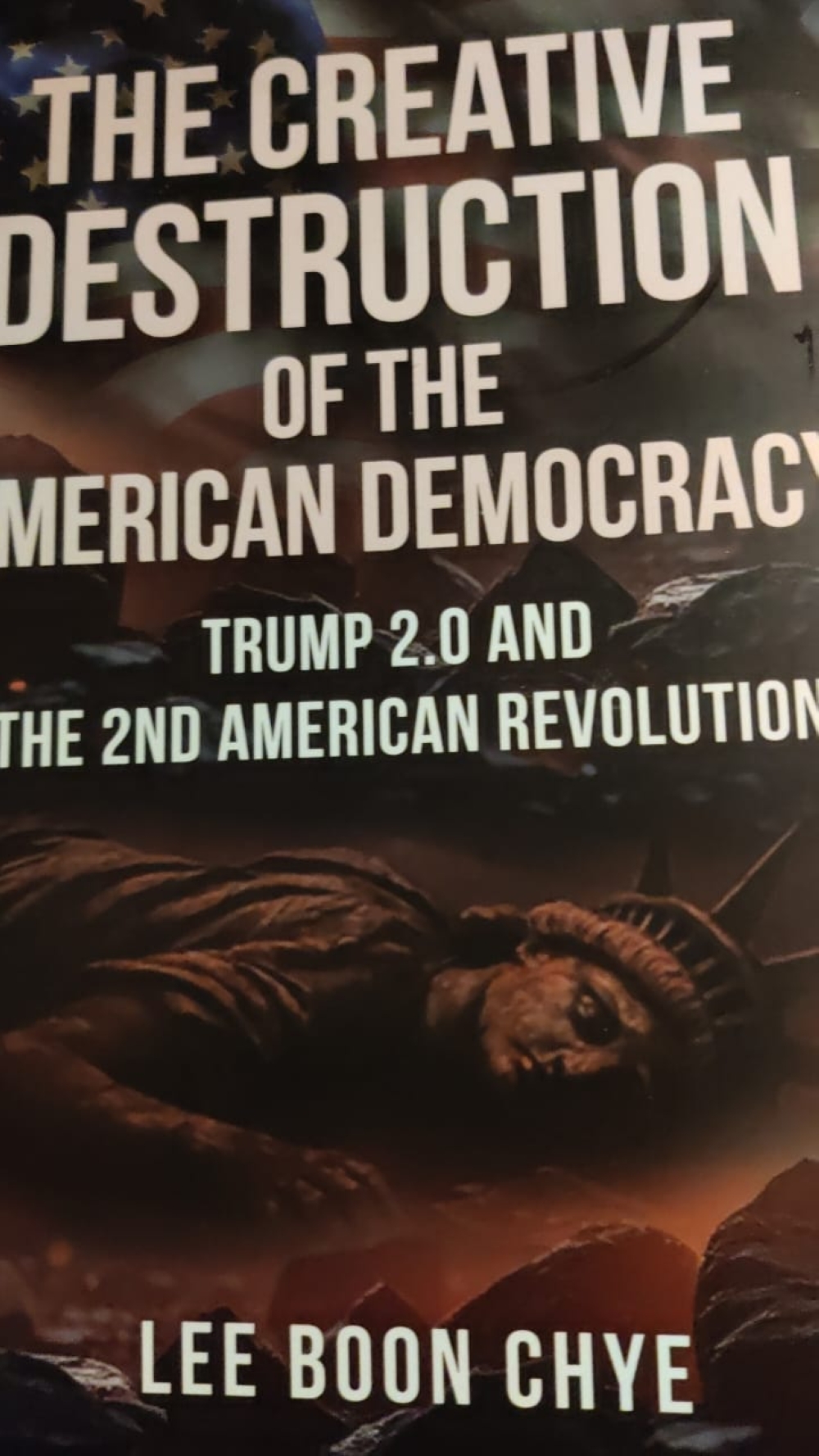
On October 16, a fresh perspective emerged in the realm of American politics, courtesy of Datuk Lee Boon Chye's latest publication, "The Creative Destruction of The American Democracy: Trump 2.0 and the 2nd American Revolution." The book has rapidly garnered attention for its provocative stance on the country's democratic trajectory.
Lee Boon Chye argues that the United States, once heralded as an enduring constitutional democracy, is now grappling with a myriad of internal contradictions. These include deep-seated issues such as inequality, political polarization, and a waning faith in its own institutions. The author's central thesis is that these problems are not solely the result of President Donald Trump's presidency but are, rather, products of decades of accumulated grievances related to stagnant wages, widening wealth disparity, dwindling social mobility, and the growing influence of wealthy elites on public policy.
The book is divided into 18 chapters, each contributing to a comprehensive argument that links contemporary political turmoil in the U.S. with the philosophical underpinnings of its republic. It begins with the electoral victories of Trump in 2016 and 2024, followed by an exploration of the underlying socioeconomic conditions that enabled such political upheavals.
Lee is particularly convincing in his explanation of how economic growth and corporate profitability have become increasingly detached from the living standards of ordinary Americans. Despite significant productivity and financial market growth, many working-class households have struggled to witness comparable improvements in their purchasing power.
This disparity exposes the limitations of neoliberal capitalism, particularly its assumption that economic prosperity will automatically lead to broader social benefits.
The book delves into various social issues, such as healthcare inequality, opioid addiction, mass incarceration, gun violence, homelessness, suicide, and unequal educational opportunities. Rather than treating these issues as isolated challenges, Lee presents them as interconnected facets of an economic and political system that is increasingly unable to bridge private prosperity with collective welfare.
His analysis of healthcare is particularly enlightening. Despite substantial healthcare expenditure, the United States continues to grapple with significant disparities in medical access and health outcomes, showcasing how market mechanisms alone cannot always compensate for effective public governance. Additionally, Lee's examination of the American criminal justice system, including the Jeffrey Epstein case, highlights the broader issue of how wealth and political connections can grant certain individuals privileges not available to the average citizen.
However, some of the allegations and interpretations surrounding Epstein might benefit from a more rigorous distinction between established evidence, disputed claims, and pure speculation.
Intriguingly, Lee revisits the American Revolution and the philosophical contributions of Thomas Hobbes, John Locke, Jean-Jacques Rousseau, and Montesquieu. Here, he challenges the notion that America's founding constitutional arrangements remain applicable in today's changing historical context. He posits that while constitutional durability is important, it can also become rigidity.
The Electoral College, enduring two-party competition, the expense of electoral campaigns, and the difficulty of constitutional amendments have collectively hindered meaningful institutional renewal. Consequently, American democracy might be proceeding down a path of procedural competitiveness without substantive responsiveness.
This is perhaps the book's most compelling observation: democratic legitimacy cannot be solely dependent on periodic elections. Instead, it must also rest on institutions capable of translating public preferences into effective governance.
Lee's analysis extends beyond the U.S. context, carrying significant implications for readers in Malaysia and other ASEAN countries. His examination of American democracy and its contradictions offers valuable insights and lessons that can resonate across different political landscapes.
Written by urgent.news from Malay Mail's reporting — not their text. Machine-written — may contain errors; check the original before relying on it.