India has more Restrictive Labor Law than Germany
In Premature Imitation and India’s Flailing State, Shruti Rajagopalan and I discuss how India has essentially all of the laws of a developed country but at much lower state capacity–this mismatch creates what we call premature imitation, with a host of negative consequences. What is even more amazing, however, is when a country like India […] The post India has more Restrictive Labor Law than…
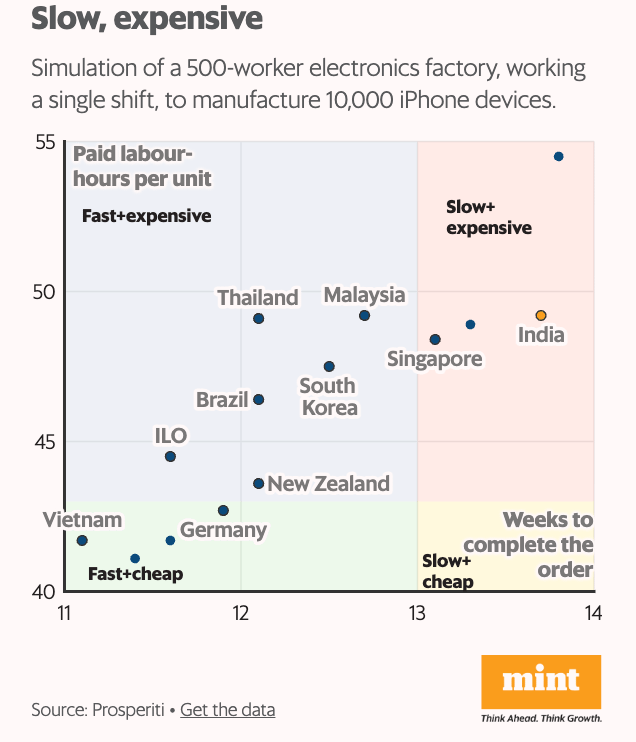
A recent analysis reveals that India's labor laws are more restrictive compared to Germany's. Rajagopalan and the author of the source examine how India possesses numerous laws characteristic of a developed nation, yet exhibits lower state capacity. This discrepancy leads to premature imitation, causing several negative outcomes. One notable example is the labor regulations, where India mandates stricter rules than Germany.
Germany and India share an 8-hour standard working day, but India mandates overtime pay at twice the regular rate, which is uncommon in most developed countries where the standard is 1.5 times the regular rate. Additionally, Germany's overtime rate varies depending on bargaining agreements, while India maintains a fixed rate. Another significant difference is the maximum number of overtime hours allowed.
India caps this at 144 hours per quarter, whereas Germany does not have a statutory cap but limits total hours to 10 per day and 48 per week on average.
The weekly cap and double overtime pay make it challenging to meet rush or large seasonal orders. For instance, consider a hypothetical 500-worker electronics factory in each of the 16 countries analyzed. When faced with an order for 10,000 devices to be completed in three months, such as for a September iPhone launch, the Indian factory takes 13.7 weeks to deliver, which is 23% longer than the other factories.
This delay occurs because the Indian factory cannot adapt its regular hours throughout the production cycle; it can only rely on overtime. Moreover, the Indian factory cannot compete on cost either. To complete the iPhone order, the factory pays for 49.3 labor-hours per unit, which is at least 18% more than the factories at the cost frontier. This cost is high because 144 of the 800 production hours per worker are paid as overtime at twice the regular wage, raising the total paid labor to 985 hours for 800 hours of output.
In conclusion, the combination of slow delivery and high costs makes India an unattractive manufacturing destination. Interestingly, producing iPhones in Germany is actually cheaper and faster than in India, even on an equal-wage basis. However, wages are not equal, and productivity differs. The critical takeaway is that the chart highlights the impact of India's regulatory inflexibility on its manufacturing competitiveness.
Despite firms and workers in India attempting to circumvent overtime rules, this practice predominantly affects small Indian firms rather than the large international firms, like Foxconn, that India aims to attract but must comply with the existing laws.
Written by urgent.news from Marginal Revolution's reporting — not their text. Machine-written — may contain errors; check the original before relying on it.