Elektromobilität: Wo Elektroautos besonders boomen
Förderung, breitere Auswahl und die hohen Spritpreise treiben die Elektroautoneuzulassungen in Deutschland. In zwei Bundesländern fährt dieses Jahr schon fast jedes neue Auto mit nur Strom.
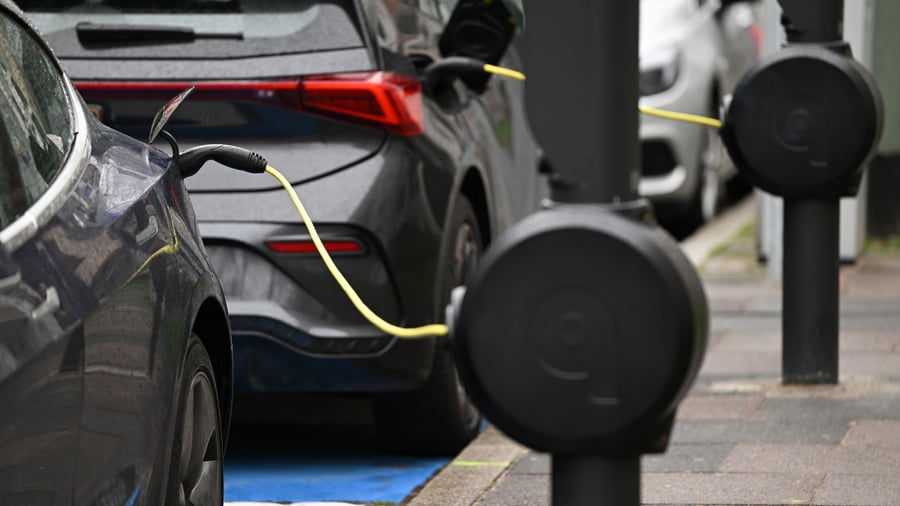
Elektroautos are becoming increasingly popular in Germany, but their growth varies by region. According to data from the German Federal Motor Transport Authority, the highest proportion of new registrations in 2022 is in Rhineland-Palatinate, at 33.1 percent. This means that nearly one in three new cars registered in the state runs solely on electricity.
Schleswig-Holstein also shows a high rate, with 32.6 percent of new cars being electric. The third-highest rate is in Lower Saxony, with 29.8 percent. Notably, the growth in vehicle registrations in a state like Lower Saxony depends not only on the population but also on both small and large businesses. This could also be the case in Baden-Württemberg, where there are brands like Mercedes and Porsche, with a rate of 29.7 percent.
North Rhine-Westphalia follows with 29.3 percent, ahead of Bremen at 28.9 percent. Bavaria, Berlin, Brandenburg, and Saarland are close to the national average of 27.2 percent. Hamburg has the lowest rate, at 16.9 percent, which is just over one in six cars. Following Hamburg are Saxony and Saxony-Anhalt at 21.6 and 21.7 percent, respectively.
Thuringia, Hesse, and Mecklenburg-Western Pomerania have relatively low values at 22.4, 22.5, and 23.2 percent, respectively. Compared to the previous year, the share of electric cars has increased in all regions. Nationally, this represents a 9.1 percent increase. Most federal states are relatively close to this figure, but there are some outliers: most notably, Rhineland-Palatinate, which not only has the highest rate at 33.1 percent but also the strongest growth at 13.8 percentage points.
The Saarland has seen a 12.9 point increase, while Schleswig-Holstein has increased by 11.7 points. At the other end of the spectrum, Hamburg has increased by just 3.8 points, while Hesse and Niedersachsen have each seen an increase of 7.6 percentage points.
Written by urgent.news from Handelsblatt's reporting — not their text. Machine-written — may contain errors; check the original before relying on it.