Astronomie: Was vier Riesenspiegel auf der Insel La Palma suchen
Ein Fehlalarm bei der Suche nach verbotenen Atomtests führte Wissenschaftler zu einem Signal aus dem All. Auf La Palma fangen nun vier riesige Spiegel ein schwaches blaues Leuchten ein. Was verrät es?
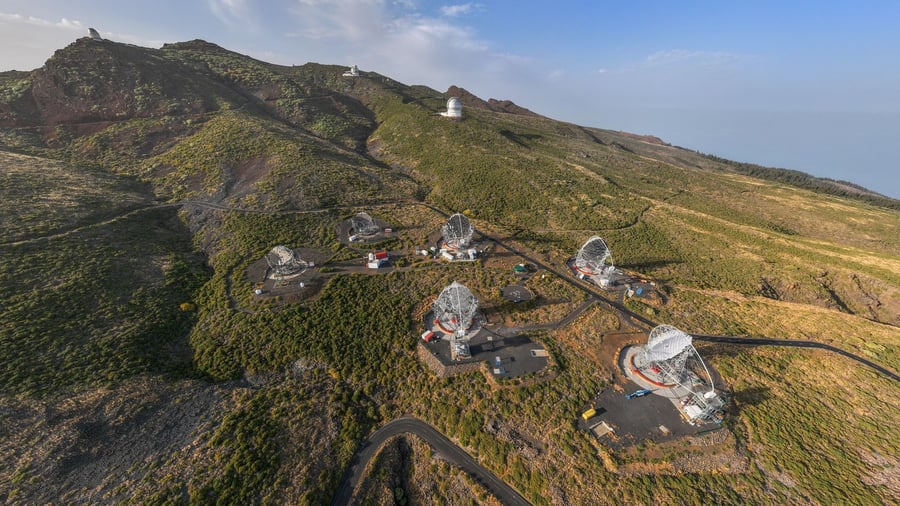
On the Canary Island of La Palma, four enormous mirrors with numerous facets, gazing at the sky, have caught the attention of many tourists. Perched at a height of 2,200 meters on the summit of Roque de los Muchachos, these mirrors will collectively search for high-energy gamma radiation from distant galaxies. This week, the "LST Subarray," a facility named after the telescopes, was officially inaugurated for guests from politics and academia.
Masahiro Teshima, from the Max-Planck-Institut für Physik, explained that the completion of the LST-Subarray represents the culmination of over 15 years of international collaboration and technological innovation. These telescopes will enable scientists to explore some of the most extreme environments in the universe, including supermassive black holes, neutron stars, the origins of cosmic rays, and the nature of dark matter.
The discovery of cosmic gamma rays dates back to 1967 when a random find, in fact a malfunction, led American scientists to detect gamma radiation from space. Two satellites were searching for traces of banned atomic tests in the atmosphere, which would be indicated by gamma rays. On July 2, 1967, two satellites registered a strong gamma flash, which turned out not to come from the atmosphere but from outer space.
Observing cosmic gamma rays from the ground is challenging, as when gamma radiation hits atmospheric molecules, it creates a violent shock wave of millions of electrically charged particles in just 50 kilometers altitude. This results in a strange phenomenon: an optical "supersonic boom" or Tscherenkow light, named after its discoverer Pawel Tscherenkow.
To capture this light, astronomers use large mirrors. By observing with multiple telescopes from different angles, researchers can precisely determine the energy of the original gamma rays and the direction from which they originated, thus identifying the objects they come from and how they were formed. The four gamma telescopes on La Palma are each 23 meters in diameter and consist of 198 identical, six-sided mirror facets.
One test of the novel design concept was already in operation in 2018, immediately proving successful by detecting gamma radiation from a galaxy eight billion light years away. The newly inaugurated facility on La Palma, however, is not alone. It is the first part of the Cherenkov Telescope Array Observatory (CTAO), which will be expanded by 2030 with a total of 64 telescopes to become the world's largest and most sensitive ground-based observatory for high-energy gamma radiation.
To observe the entire sky, CTAO needs a second location in Chile's Atacama Desert, from which researchers will also be able to observe the center of our Milky Way, where there are particularly many neutron stars and black holes emitting gamma rays.
Written by urgent.news from Handelsblatt's reporting — not their text. Machine-written — may contain errors; check the original before relying on it.