Officials celebrate completion of gamma-ray telescope array in La Palma
The Large-Sized Telescope will provide new insights into the early universe The post Officials celebrate completion of gamma-ray telescope array in La Palma appeared first on Physics World .
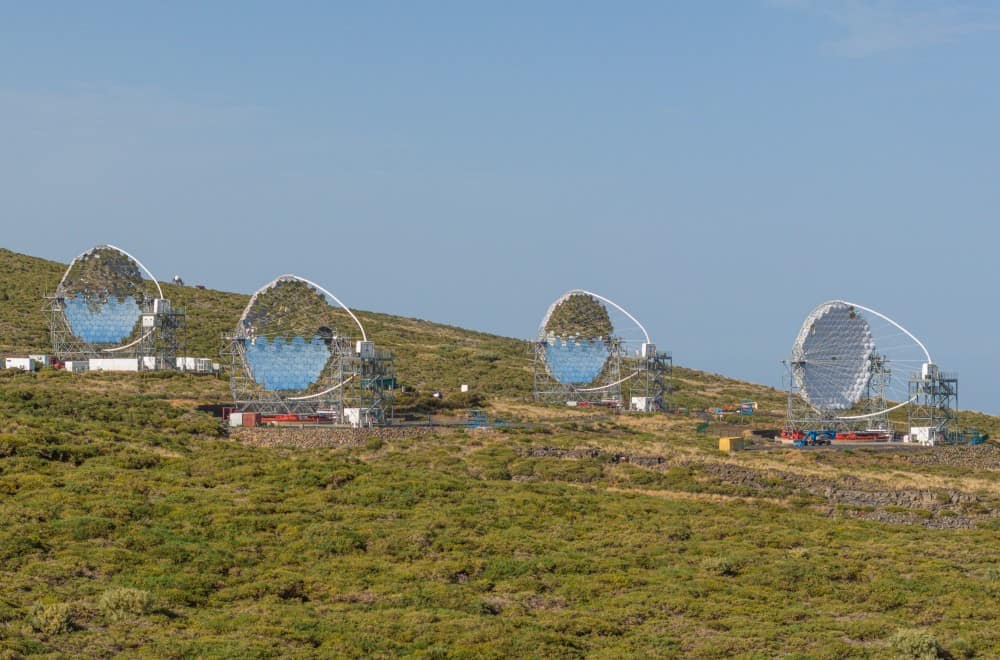
On a recent occasion, 250 scientists and officials gathered to commemorate the completion of a large-scale telescope complex situated in La Palma, Spain. This complex, known as the Large-Sized Telescope (LST) array, is housed at the Roque de los Muchachos Observatory. Comprising four 23-meter diameter telescopes, the LST array is specifically engineered to detect faint Cherenkov light flashes generated by high-energy gamma rays as they interact with the Earth's atmosphere.
These LSTs are regarded as the most sensitive instruments available for observing gamma rays with energies ranging between roughly 20 GeV to 3 TeV.
The first LST-1 telescope was constructed back in 2020 and has already made significant contributions by observing pulsars, studying active galactic nuclei at vast cosmological distances, and providing rapid follow-up observations of transient phenomena such as novae and gamma-ray bursts. The inclusion of the remaining three telescopes will enhance the overall sensitivity, angular resolution, and energy reconstruction of the array.
By capturing the same gamma-ray showers from multiple directions simultaneously, the improved sensitivity will allow astronomers to detect and study bright gamma-ray bursts at high redshifts. This capability could potentially extend gamma-ray observations to sources at redshifts around z∼4, thereby shedding new light on the early universe.
As per Japanese astrophysicist Masahiro Teshima, principal investigator of the LST collaboration, the completion of the LST sub-array represents the culmination of over fifteen years of international collaboration and technological innovation. Teshima further expressed that these telescopes will enable scientists to delve into some of the most extreme environments in the universe, including supermassive black holes, neutron stars, and the nature of dark matter.
The LST array will form an integral part of the Cherenkov Telescope Array Observatory (CTAO). Upon completion in 2028, the CTAO will operate within a spectrum of 20 GeV to 300 TeV, making it the world's most powerful observatory for gamma-ray astronomy. The CTAO will encompass six LST telescopes alongside two additional arrays: 23 Medium-Sized Telescopes (MST) operating between 80 GeV to 50 TeV, and 37 Small-Sized Telescopes (SST) functioning between 2 TeV and 300 TeV.
These 66 telescopes will be strategically distributed between CTAO-North at La Palma and CTAO-South at the Paranal Observatory in Chile's Atacama Desert. The LSTs will serve as the low-energy core of CTAO-North, with the telescopes set to undergo commissioning and integration into the CTAO operations in the coming years.
Written by urgent.news from Physics World's reporting — not their text. Machine-written — may contain errors; check the original before relying on it.