How to Train Your Robot
The enormous advance in AI capabilities over the last several years has in large part been driven by the availability of vast amounts of training data.
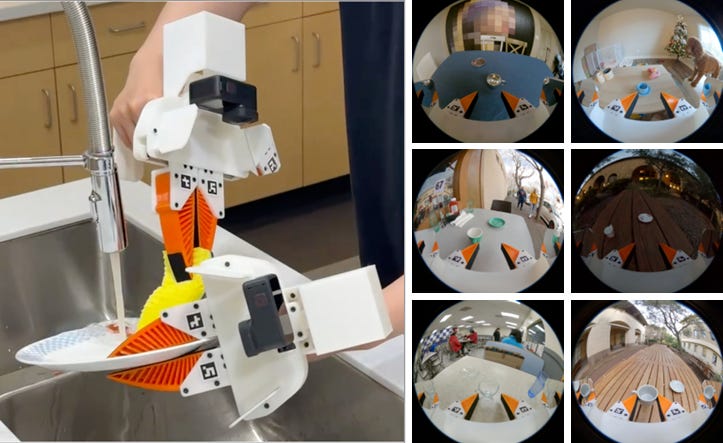
The rapid growth of artificial intelligence over recent years has primarily been fueled by the abundance of training data accessible. According to Gwern's 2020 essay "The Scaling Hypothesis," the key to achieving artificial general intelligence (AGI) lies in employing larger models, expanded datasets, and more computing power for training these models.
Gwern contends that intelligence essentially involves applying simple neural units and learning algorithms to diverse experiences on a scale that is otherwise unattainable. As computational resources continue to increase, enabling the execution of these algorithms at the required scale, neural networks become increasingly intelligent.
In a 2024 article, pseudonymous AI researcher Nostalgebraist highlighted the notion that the present AI landscape is rooted in the realization that machine learning models progressively improve and yield accurate predictions as they are trained on ever-increasing amounts of data. This concept has since been applied across various AI domains, including robotics.
A critical query that arises as more attention is directed towards integrating modern AI techniques into robotics is: "Where will the training data for robots originate?" While language models can be trained on massive existing bodies of text, such as the 300 billion tokens used to train GPT-3, sourced from internet scraping, there is a notable absence of a comparable quantity of high-quality, publicly available robot training data.
This challenge has become a focal point for the robotics field, as efforts intensify to harness AI advancements in this domain.
Robot training data encompasses a multitude of examples demonstrating correct actions or providing sufficient knowledge of what constitutes a correct action to enable the scoring of model outputs. In the case of text-based AI models, a single training example can consist of an existing text segment, with the model predicting the subsequent elements of the sequence.
By feeding the model various parts of this single chunk of text, numerous training examples are generated. This process of learning from exemplar data is a fundamental aspect of training AI models across different applications, including robotics.
Written by urgent.news from Construction Physics's reporting — not their text. Machine-written — may contain errors; check the original before relying on it.