'World's oldest known' shipwreck revealed with Sydney archaeologist's help
An archaeologist from Sydney reveals her role in the discovery of the 'world's oldest known' shipwreck, found in southern Türkiye.
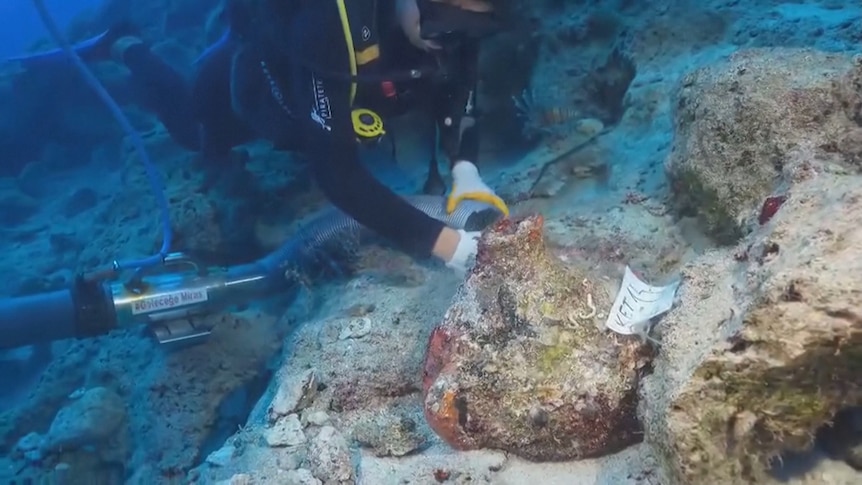
Archaeologists have uncovered the world's oldest shipwreck off the coast of Turkey, with an estimated age ranging from 4,400 to 4,700 years old. Although the ship's structure has not endured the millennia underwater, its contents have remarkably survived, preserving some clay jars that still contain traces of their 4,000-year-old cargo. The vessel, a 33-foot-long trade ship, is believed to have originated from the eastern Mediterranean coast and was transporting goods across the Mediterranean Sea.
Turkey's Culture and Tourism Minister, Mehmet Nuri Ersoy, stated that the shipwreck will provide valuable insights into ancient trading connections and the daily lives of seafarers. Hakan Öníz, an associate professor at Turkey's Akdeniz University who led the expedition, described the site as a "time capsule" at the bottom of the sea. Three stone anchors were also discovered alongside the 30 ceramic storage jars, known as amphorae.
Initially, the archaeologists thought the amphorae were only a century or two old when they first found the wreck four years ago. However, upon recognizing their similarities with pottery found at the Giza pyramids in Egypt, they returned to the site and realized their true age. These amphorae, characterized by their two handles, flat base, and middle ridge, are distinctive to pottery from that period.
Karin Sowada, an archaeologist at Australia's Macquarie University, examined the pots after they were brought to the surface and was astonished by the viscous, glossy residue still present in some of the amphorae. Analysis of the clay suggests that the jars were produced in workshops in the Middle East's Jordan Valley, likely containing olive oil or wine.
The ship is believed to have sunk while transporting these goods westward, possibly to Troy or the Minoan civilization in Crete. Similar amphorae have also been found in Egypt, Troy, and Crete.
For Öníz, the discovery meant being the first humans to touch these objects after 5,000 years, reflecting on the lives of those connected to the ship, including the sailors, producers, and the women who waited for their husbands.
Written by urgent.news from CBS News's reporting — not their text. Machine-written — may contain errors; check the original before relying on it.
This story
This is one outlet's version. Read the fullest account.
- World’s oldest shipwreck discovered off coast of Turkey theconversation.com
- World's oldest shipwreck found off Turkey's coast, archaeologists say cbsnews.com
- Oldest Bronze Age merchant shipwreck discovered off Turkey english.ajel.sa
- World’s oldest shipwreck found off coast of Turkiye aljazeera.com