Wälder: Gefährlicher Kurs: Länder holzen viel zu viel Regenwald ab
Bis 2030 wollten mehr als 100 Staaten die großflächige Abholzung stoppen. Trotz eines Rückgangs im vergangenen Jahr ist der Abstand zum Ziel groß. Eine Region entwickelt sich besonders kritisch.
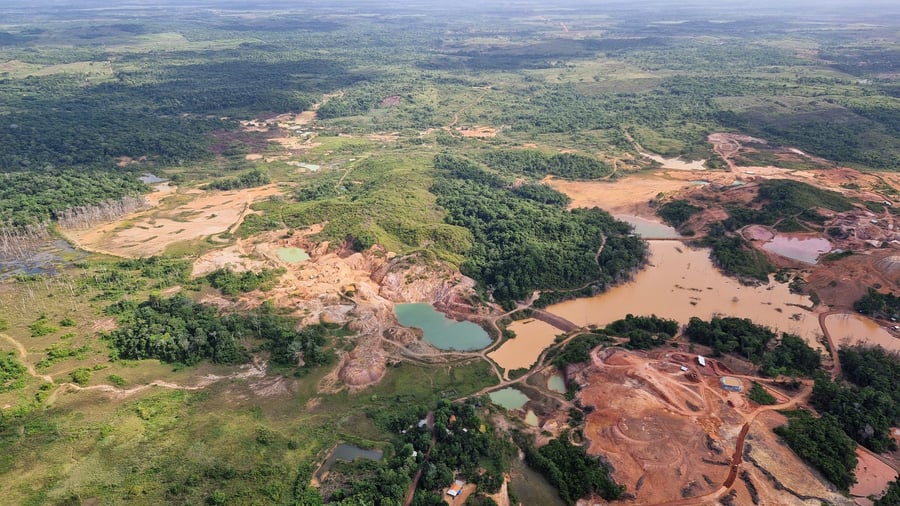
By 2030, countries were supposed to halt the large-scale logging of forests – a goal at least widely endorsed by a broad coalition of nations. However, the world is far from this course, according to a recent analysis by the consulting firm Climate Focus. Using data and information from over two dozen civil society and research organizations, Climate Focus compiled a “Forest Declaration Assessment” inventory.
While there was a decline in deforestation last year, the authors note that this has not been enough. At the 2021 Glasgow climate summit, over 100 countries committed to stopping the destruction of forests and other landscapes by 2030. Forests are considered the planet's lungs, absorbing about a third of the annual carbon dioxide emissions caused by human activities.
Less logging in 2025 is necessary, but still far too much. According to Climate Focus's analysis, 7 million hectares of forest were logged in 2024 – a 15% decrease compared to the previous year. The team used 8.3 million hectares per year logged between 2018 and 2020 as a reference point to measure progress or the lack thereof. Between 2021 and 2024, deforestation barely deviated from the level of previous years.
Ideally, each year should have seen no more than 1 million fewer hectares of forest logged to reach zero by 2030. In 2024, no more than 5 million hectares could have been logged – instead, it was still 8. In 2025, only 4.2 million hectares should have been logged – much less than the actual 7. "It is a welcome fact that we lost 15% less forest in 2025 than in 2024, but this looks better only partly because the previous years were so bad," explains the report's lead author, Erin Matson, senior advisor at Climate Focus.
Forest loss in Africa is moving in the wrong direction. For the first time since recording began, tropical Africa (with 2.4 million hectares in the Congo Basin) had similar levels of loss to tropical Latin America (2.5 million hectares). The two regions had previously taken different paths. While Brazil's measures under President Luiz Inácio Lula da Silva led to a 33% reduction in the region, the Congo Basin showed no signs of reduced deforestation.
This comes mainly from agricultural expansion, logging, and mining. "The facts show us that the underlying forces that destroy the world's forests – distorted economic incentives, weak governance, and insufficient protection for indigenous peoples and local communities – remain omnipresent," Co-author Ivan Palmegiani stresses. "Ultimately, the crisis we see in our forests is really the consequence of a broader crisis in economic and governance systems that enable and even promote their destruction."
Progress can quickly reverse This connection is also a reason why the author team is cautious about prognoses. The progress made so far is far from clear that it will continue. The protection of forests relevant to the global climate depends on decisions by a few key governments – and their policies could change rapidly. This is particularly relevant for Brazil.
Currently in office, Lula faces a runoff election against his right-wing challenger Flávio Bolsonaro – son of former President Jair Bolsonaro – on October 25. During Bolsonaro's tenure, annual deforestation in Brazil's Amazon region expanded significantly; only with Lula did the turnaround occur. Deforestation in Brazil's Amazon last year was as low as it has been in a decade, according to data from the National Institute for Space Research (Inpe).
Brazil holds a key role in critical times. As host of the last year's climate conference, Lula promoted a novel approach called the Tropical Forest Forever Facility (TFFF), aiming to make forest protection more attractive: countries that preserve their forests should be rewarded, while those that destroy one hectare of forest should pay a penalty.
Satellite images would verify this. Germany pledged a billion euros over a ten-year period for the fund. However, the fate of the fund in case of Bolsonaro's election remains uncertain. The report's authors also point out that the next Brazilian president's term is a critical time window. The world could officially cross the 1.5-degree threshold, at which point global warming was actually supposed to be halted.
Johan Rockström, director of the Potsdam Institute for Climate Impacts Research, warned at a climate conference during a side event in the Amazon last year that if the rainforest is heavily burdened, it could irreversibly transform into a savannah. "If we exceed 1.5 degrees, which we very likely will in the next 5 to 10 years, and if we continue losing forest area, we cannot rule out that we will reach this tipping point in the coming decades," the prominent climate researcher said. "We all depend on the Amazon rainforest to ensure a stable climate."
Written by urgent.news from Handelsblatt's reporting — not their text. Machine-written — may contain errors; check the original before relying on it.