The Perseverance Rover Reaches Another Milestone
NASA's Perseverance Rover has reached another milestone. It now holds the record for the longest distance travelled on another world, meaning Mars and Earth's Moon. It's all thanks the ingenuity behind AutoNav, it's hazard-detection driving system. It's a win for science, as more distance travelled means more scientific objectives are reached.
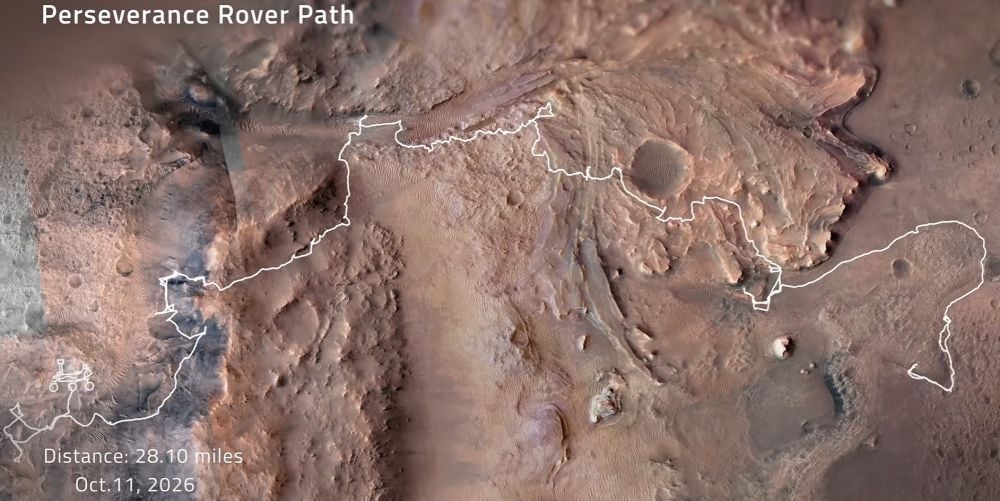
After five-and-a-half years traversing Mars, NASA's Perseverance Rover has achieved a distance record for travel on another world. Since landing in the Jezero Crater on February 18, 2021, Perseverance has covered 45.22 kilometers (28.10 miles), surpassing the 45.16 kilometers (28.06 miles) traveled by NASA's Opportunity rover. Notably, Perseverance accomplished this in just 5.5 years, whereas Opportunity took nearly 15 years.
Comparing the two rovers based on distance traveled appears unfair, as Perseverance is plutonium-powered, while Opportunity relied on solar power.
Perseverance is currently stationed in a region known as "Lac de Charmes," located at the western end of Jezero Crater. It reached this milestone while moving towards a scientific target called "Idubi," which is notable for its ancient rocks. These rocks are unique, as none exist on Earth due to plate tectonics, which have destroyed all ancient rocks.
On Earth, sedimentary rocks are known for preserving evidence of ancient life, but Perseverance found igneous rocks instead, as well as fluorite, which forms when rock interacts with heated water. This discovery indicates hydrothermal activity, a critical factor in astrobiology because hydrothermal systems can preserve evidence of ancient life, such as fossilized microbial structures, organic molecules, and even microbial mats.
The rover's ability to cover long distances is attributed not only to its power source but also to its autonomous navigation system, AutoNav. AutoNav continuously captures images of the terrain and creates a 3D map of hazards, allowing the rover to plot its own course while maintaining high speeds. This system has enabled Perseverance to travel up to 412 meters (1,351 feet) in a single Martian day, significantly surpassing the capabilities of its predecessors, Spirit and Opportunity.
Written by urgent.news from Universe Today's reporting — not their text. Machine-written — may contain errors; check the original before relying on it.