Reinhold Würth: Herr der Schrauben und Mäzen: Wie der Milliardär sein Kulturimperium ausbaut
91 Jahre alt, 21.000 Kunstwerke, 14 Museen weltweit: Der Unternehmer eröffnet in Schwäbisch Hall seine erweiterte Kunsthalle – und der Bundespräsident nutzt den Festakt für eine Warnung.
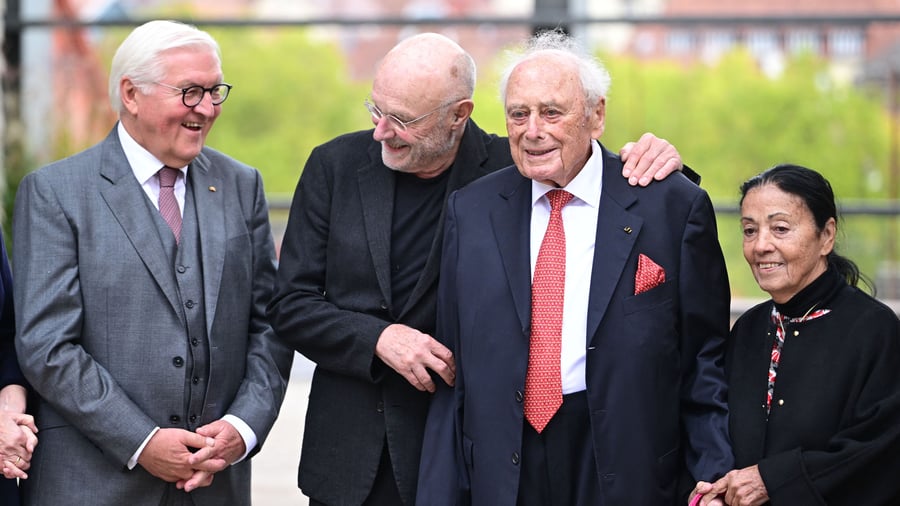
Reinhold Würth, the conglomerate mogul known for his screw and nut empire, has also amassed a significant art collection, transforming it into a cultural empire. At the age of 91, Würth is not just a businessman, but also a passionate art patron. When he opens a museum, the elite gather to celebrate. This was evident on Tuesday in Schwäbisch Hall, where Federal President Frank-Walter Steinmeier, Prime Minister Cem Özdemir and 600 dignitaries attended the inauguration ceremony at St.-Katharina-Kirche.
A 25 million euro investment in Schwäbisch Hall for the museum is modest compared to Würth's other endeavors. He maintains 14 museums worldwide where visitors can view his art for free, holding over 21,000 artworks from the late Middle Ages to contemporary times, including works by Anselm Kiefer, Max Ernst, Christo and Jeanne-Claude, and David Hockney.
The collection is one of Europe's most active private art collections, attracting over five million visitors since its founding 25 years ago. The museum in Schwäbisch Hall has been expanded by around 600 square meters, offering a continuous route through the house and new spaces for art education and audiovisual content. Federal President Steinmeier praised Würth's entrepreneurial commitment to democracy and art, referring to the German-Jewish painter Max Liebermann.
"It reminds us of how closely free art and liberal democracy are intertwined, and it reminds us that we must protect these civilizing achievements from anyone who seeks to harm them," Steinmeier said. "A decade ago, the danger seemed abstract, but now we fear the Bauhaus in Dessau's survival," he added. Numerous other institutions face similar challenges.
Würth emphasized that he is not just interested in his balance sheets, but also in the well-being of society and assumes responsibility for democracy. "They are the countermodel to a trend I observe with great concern, particularly in the United States," Steinmeier warned. Reinhold Würth is now only the honorary chairman of the Foundation Supervisory Board of the Würth Group, having relinquished all operational positions.
However, his words still carry weight within the company. The opening ceremony for the renovated museum features a solo exhibition titled "Anselm Kiefer - Everything that Falls," showcasing over 70 works from Würth's collection and 21 loaned pieces by the artist. Würth feels particularly connected to Kiefer, whom he has known for years.
"I was surprised by the incredible force in his work and also by its grounding in the region," Würth said. "In many of his paintings, one can sense a certain groundedness and his engagement with our history." The relationship between collector and artist extends beyond the usual bounds. To mark Würth's 85th birthday, Kiefer gifted him an airplane-themed photo with the inscription "Reinhold Würth Herzlichen Glückwunsch I Anselm Kiefer."
Kiefer is among the most successful artists economically, alongside Gerhard Richter and Neo Rauch. Würth, as a major customer, contributes to this success. "It's fantastic to be here and see the Anselm Kiefer showcase – an exceptional artist with whom the Würth couple brings us together," said Baden-Württemberg's Prime Minister Cem Özdemir, praising the Würth family's commitment to the arts in Baden-Württemberg.
Beyond the Schwäbisch Hall exhibition, Kiefer's work also finds a new permanent home in Künzelsau. The Anselm-Kiefer Pavilion at Museum Würth 2, designed by Sir David Chipperfield, is dedicated to the monumental work "Black Flocken," which first appears in a dedicated building and measures about eleven meters in height. Maria Würth, Reinhold Würth's granddaughter and the business unit head for art and culture at the Würth Group, manages the entire collection.
Most of the works belong to the company, and despite regular appraisals, considerable silent reserves are likely to exist in the balance sheet. Reinhold Würth has never resold any artwork, as he himself stated. Recently, he acquired Holbein's Madonna for an estimated 50 million euros, described as the most significant German Renaissance panel painting, and Max Beckmann's Self-Portrait in Yellow-Orange for 20 million euros, reportedly "under cover."
Written by urgent.news from Handelsblatt's reporting — not their text. Machine-written — may contain errors; check the original before relying on it.