Recyclingwirtschaft: Wie Ghana den Elektroschrott als Chance nutzen will
Brennende Kabel, giftiger Rauch: Ein Schrottplatz in Ghana wurde zum Sinnbild der globalen Elektroschrottkrise. Doch die Menschen dort verstehen etwas vom Recycling. Nun sollen sie es sauberer machen.
Germany generated a record 3.4 million tons of new electronic devices in 2025, but only collected 960,000 tons of used electronics. Despite the legal requirement, Germany has failed to meet this goal for years. Valuable metals like copper, aluminum, gold, and others are hidden within these devices. Studies commissioned by the German Environmental Aid found that better collection and processing could recover additional raw materials worth more than two billion euros annually.
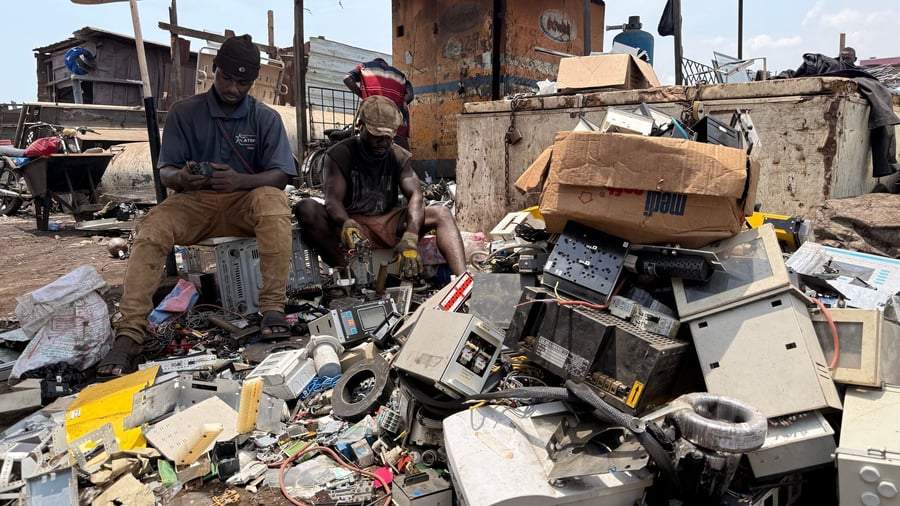
Globally, 62 million tons of e-waste were produced in 2022, but only one-fifth was properly collected and recycled. Illicitly, some e-waste makes its way to Africa, where even broken devices can still bring in money. Ghana's capital, Accra, is at the center of this global problem. The Agbogbloshie scrapyard was once listed among the ten most polluted places in the world due to the contamination caused by burning cables to extract copper.
Although the authorities cleared a landfill in the Old Fadama district in 2021, the traders simply moved to another location, only to return later. Thousands of people in Accra are directly or indirectly involved in the processing of used electronics, with their livelihoods depending on it. Among them is Yakubu Adam, a 53-year-old man with a yellow Borussia Dortmund jersey.
His suppliers visit him door-to-door, buying anything they no longer need. He inspects the goods and sells what still works. Nearby, Fuseni, a cheerful man, assembles electronic components from cables in a cramped space. He repairs up to 20 units a day, earning three euros each. Larger orders are also handled here, with customers ordering replacement parts via WhatsApp.
Vincent Kyere, the project leader for e-waste at Ghana's Ministry of Environment, acknowledges the economic value of this work while emphasizing the environmental impact. The images from Agbogbloshie drew international attention to Ghana's e-waste industry. Now, the potential of the extensive network of collectors, traders, and artisans in Accra is being recognized.
These stakeholders are working to keep their income sources while preventing cable burning and uncontrolled release of pollutants. German development funds have supported this effort since 2016, training over 1,500 scrap dealers in environmentally friendly e-waste processing. GreenAd, a local company, exemplifies this approach. Instead of burning the insulation of old cables, they remove it mechanically.
They pay collectors for cables based on price lists and are increasingly receiving new goods from Asia due to quality issues. Some screens even become televisions. While better processing methods are necessary for safety reasons, Innocent Turkson, chairman of a scrap dealer association in Tema, notes that they should ultimately focus on generating income.
Repair and reuse are preferred to destruction. In his company, Electro Recycling Ghana, men and women refurbish Dell computer monitors, which cost just 30 euros each. Many clients cannot afford new devices.
Written by urgent.news from Handelsblatt's reporting — not their text. Machine-written — may contain errors; check the original before relying on it.